



Share This Article
I want to illustrate 4 scenarios that become possible if Article 3 passes as written. To be clear: I strongly support having a recall provision in our charter. Our neighboring towns – all have recall provisions as a means to hold elected officials accountable outside of standard election cycles. The issue is that Article 3 omits crucial guardrails that each of these towns chose to include to protect against misuse.
Here are the key elements of a recall process:
- Signature threshold: What percentage of registered voters must sign the petition to trigger a recall election.
- Cooling period: How soon after taking office an official can be subject to recall.
- Vote required: What percentage of voters must vote for the recall to pass.
- Turnout minimum: What percentage of registered voters must participate for the election to be valid
- Repeat attempts: Whether an official can face multiple recall efforts in a single term.
- Officer on ballot: Whether the recalled official can run as a candidate to replace themselves.
- Post-recall appointment bar: Whether a recalled official is barred from appointment to any other town office
Here is how Article 3 compares to the provisions for our neighbors:
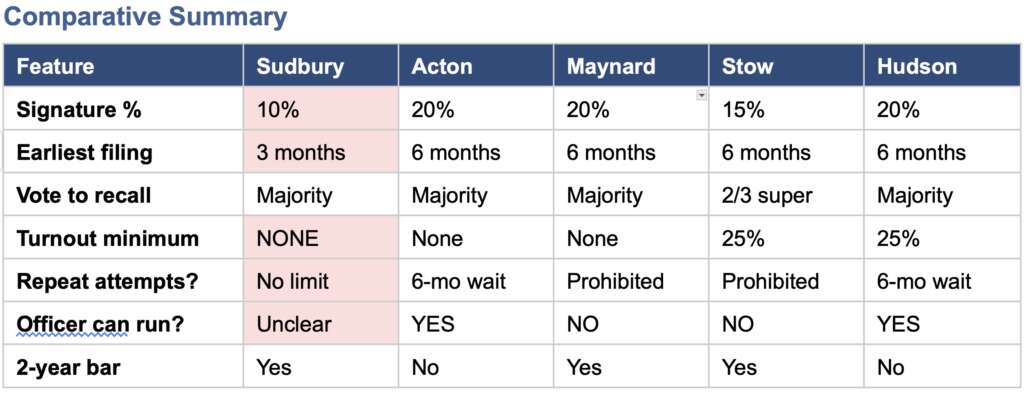
In every dimension, Article 3 is the least restrictive recall provision in the region, which can create unintended consequences. Remember, recall provisions have the potential to be used against officials you DON’T support and officials you DO support.
Scenario 1: The low-turnout recall
- Official X wins in March with 2,100 votes out of 3,300 cast.
- A recall election is scheduled for October.
- Only 1,200 people turned out for the off-cycle special election.
- The recall passes, and a replacement candidate wins with a plurality of 400 votes.
Result: An official elected by 2,100 voters is replaced by someone chosen by 400.
Scenario 2: Continuous Recall Elections
An organized group files a recall affidavit in September. It fails. They immediately refile in November with new grounds – and simultaneously target another board member. This repeats every two months across the 27-month eligible window.
Result: Even without succeeding, officials spend their terms defending against rolling recall efforts rather than governing while citizens are heading to the polls every month. Administrative costs accumulate as election season never ends.
Scenario 3: A seat ping pongs between two individuals
Candidate A wins in March. B’s supporters recall A by September; B wins the replacement seat in December. A’s supporters immediately file against B once the 3-month cooling period expires and so forth.
Result: The seat changes hands 2-3 times in a single 3-year term. The town bears the cost of multiple special elections. No one actually governs.
Scenario 4: Policy Disagreements Trigger Loss of Government Continuity
- The Select Board votes 3-2 on a divisive issue.
- Supporters of the minority file recalls against all 3 majority members.
- If all three recalls succeed, the board loses its entire working majority at once. The two remaining members must appoint three replacements- or the town faces three sequential special elections.
- Even if some recalls fail, the board is paralyzed for 4-6 months while members campaign for survival rather than govern.
- And a practical question emerges: if three of five members face active recalls, can they vote on recall-related decisions like scheduling and election budgets? Can a two-member board function?
Result: A coordinated group can remove an entire governing majority – creating policy whiplash, loss of institutional knowledge, and multiple special elections – all triggered by a routine 3-2 vote.
Not the Outcomes Sudbury Is Looking For
Recall is a legitimate tool for democratic accountability- and our neighboring towns prove it can work. But neighboring towns all built in guardrails: higher thresholds (15-20%), longer cooling periods (6 months), protections against repeated attempts, and clear safeguards to prevent misuse.
As written, Article 3 sets the lowest threshold in the region, the shortest cooling period, and includes no protections against serial or concurrent use. The result is a mechanism that any organized group of 1,500 voters can deploy as many times as they want, for the entirety of an official’s term.
I urge support for Article 3 with an amendment raising the signature threshold from 10% to 20%. At 20%, recall remains achievable when an official has genuinely lost the confidence of the community- but it can no longer be triggered by the losing side of a policy debate. That’s the balance our neighbors struck, and it’s the right one for Sudbury.