Share This Article
[Editor’s Note: This article is syndicated in collaboration with The Forum — the student newspaper of Lincoln-Sudbury Regional High School. You can also read the article on the Forum’s website here.]
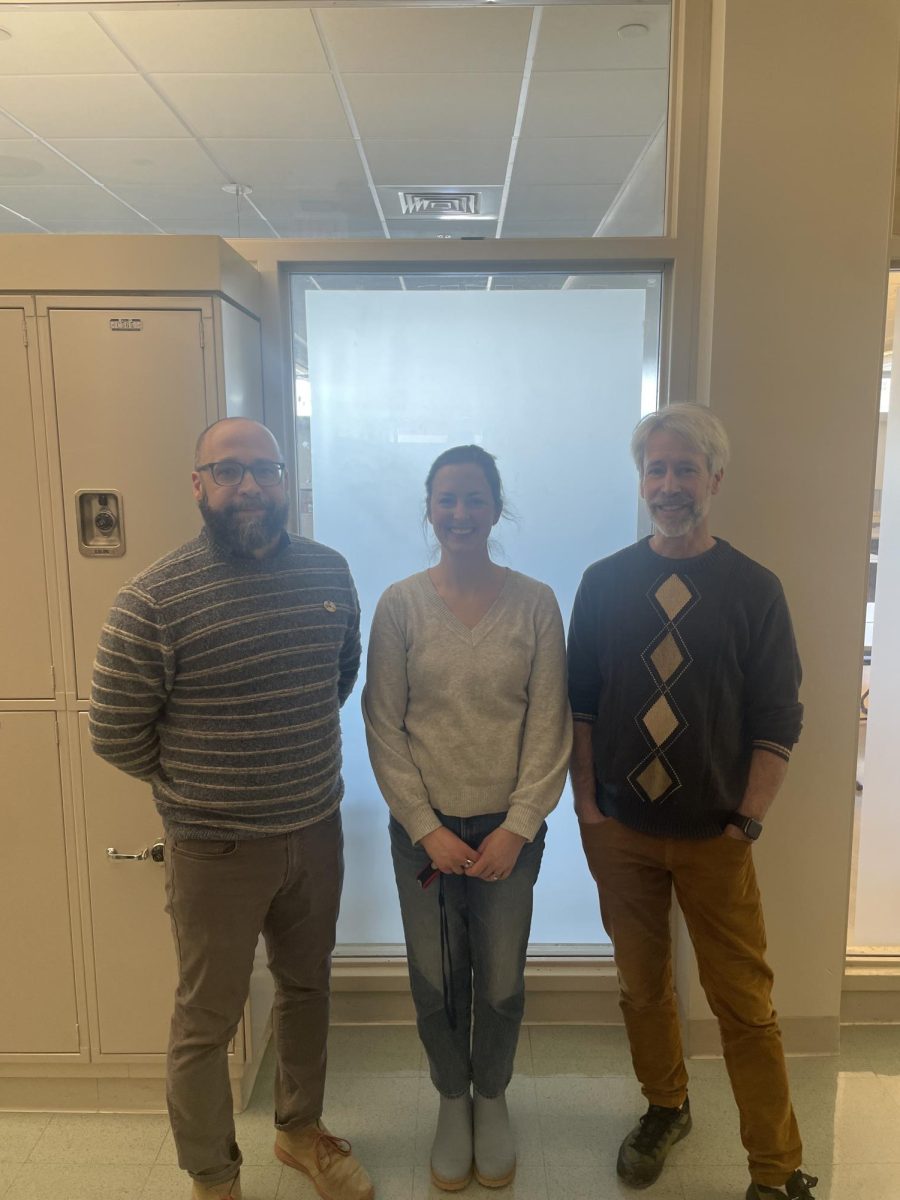
With artificial intelligence becoming increasingly prevalent in our daily lives, questions about its impact cannot be ignored. The controversy around AI’s place in society and academia highlights unresolved issues about its benefits and risks. To understand how others feel at Lincoln-Sudbury, I interviewed English teachers, Mr. Lewis, Ms. Collamore, and Mr. Mason for their perspectives on AI’s influence on both education and the human experience.
With AI progressing to a stage where it can recreate human art, it has had many artists concerned for their careers and the future of art in our society. Mr. Lewis answered by voicing concerns about AI’s impact on creative fields: “I see enormous negatives in our future coming up, largely in the creative realms where stuff that was done by individuals and that we looked up to as a society is going to be able to be produced by machines,” he said. He is also concerned about artists losing income as AI-generated work becomes more common: “I worry about the loss of a market, because if I can write an awesome country song, just by typing in a prompt, what about all the country artists that are writing songs right now?”
Mr. Lewis did not only see negatives, however, after expressing his concerns for artists, but he also explained to me that he “thinks [artificial intelligence] is freaking awesome!” He followed this by explaining the positives of artificial intelligence on his life and its possible effect in the future, “so I think that AI has enormous potential to make us more efficient for tasks that really don’t take your whole brain, but do take a lot of time. And those include, you know, responding to emails where you don’t particularly need to put your whole brain into it or figuring out the takeaways of a vast amount of language data that’s coming at you.” He told me about how AI has shortened workweeks and how he believes that, as AI improves, the time spent working will shorten.
On the other hand, Ms. Collamore talked about another controversial downside of artificial intelligence, the effect it has on the environment. She also expressed her concerns about AI’s use in “cognitive offloading.” Cognitive offloading is the process of using external tools or actions to reduce the effort one needs to put into doing something. She also said, “I’m very troubled to see that AI is so embedded in Google Docs, especially. It is worrying that an unprompted pop-up comes up that says, ‘Help me write.’ I am really concerned about how it’s being shoved down students’ throats. And I think asking students not to use [artificial intelligence] is becoming really hard to the point where I’m just having them handwrite.” Ms. Collamore is not the only teacher making her students handwrite assignments; according to EducationWeek, 76% of teachers plan to make their students handwrite assignments to prevent the use of AI.
The idea that AI is going to dominate our future and that humans will be reliant on it is explored in many sci-fi movies like WALL-E; however, Mr. Mason believes that the reliance on it will eventually slow and dissipate. He said, “I do think the reliance on [artificial intelligence] is probably going to fizzle out at some point in the near future.”
The concern for students developing necessary writing skills was a shared topic that all teachers were concerned about. Mr. Lewis said, “So if your AI manages to shortcut the development of ideas and habits of mind and critical thinking, then where are you going to get those things? I worry about that.” Ms. Collamore was also concerned about the development of students in a world dominated by AI: “What I worry about is students not developing the foundational skills of learning, how to think, and how to develop an argument.” Mr. Mason added, “I do think it gets in the way of what otherwise might be students doing their own deep thinking and working through challenges, working through difficulties, I’m concerned that it threatens their ability to develop the skills that.”
While AI could possibly pose a risk to students and schools, many teachers use it to improve lessons and classes. Ms. Collamore and Mr. Lewis both told me about how AI has been helpful in the classroom. Ms. Collamore said, “So there are a couple of assignments that I have entered the complete assignment into AI and asked for feedback. I’ve also used AI to generate a rubric.” Mr. Lewis also shared with me a tool called Brisk that he used to allow students to chat with an AI replication of a character in a book they read in class. He told me that he enjoyed talking with the character and believed he had an interesting conversation with it: “I thought it was really, really great because while the AI character was not particularly deep, it was still deeper than most people’s understanding of that character, so it could really have a great conversation.” Mr. Mason said that he had never utilized AI within his classroom. He said the reason why was “a refusal to do it or as much as I haven’t really found a need for it.”
To end our conversations, I wanted to ask a final question to all of the teachers: “How do you think a person can maintain their own voice and humanity when AI can generate text for them?” I think this question was the most important thing to come out of the interviews.
Mr. Lewis told me that students need to prioritize their human connections, and that is something that AI cannot replicate: “We’re social human beings, and we need to communicate. So giving students an opportunity to do a lot of that, to develop their voice, will not only help them to be better citizens and better interact with other people, but they’ll also be better students because you develop in relation to other people.”
Mr. Mason and Ms. Collamore both agreed. Ms. Collamore said, “I think students should be fiercely opposed to allowing robots to create in place of themselves. I have seen LS students do incredible work, whether it’s artwork or writing. I mean, I think that in letting AI generate or create for themselves, they’re not giving themselves enough credit, and they’re losing the opportunity to create the work themselves.” Mr. Mason had similar ideas, and told me that, “Even if it doesn’t sound perfect, even if it doesn’t sound the way that you think it should, that the flaws in your writing, the flaws in your speaking, the things that you create are the things that make it human and authentic in a way.”
In a world with AI becoming more and more prevalent, it is important to be yourself, be human, and know right from wrong when using AI.
Share on FacebookShare on XEmail this StoryPrint this Story