



Share This Article
This past May, Sudbury Town Meeting did something rare: it gave the Sudbury Housing Authority (SHA) a clear, funded answer to a question the town had been wrestling with for over 3 years. Voters passed Article 39, a citizens’ petition appropriating up to $500,000 from Free Cash to repair four SHA-owned single-family homes at 21 Great Lake Dr, 8 Oakwood Ave, 2 Beechwood Ave, and 9 Richard Ave — and to keep them as single-family homes. The measure was deliberately practical: capped at $500,000, no new debt, a “subset thereof” clause so work could start wherever it was most feasible, and a 24-month sunset so the town carried no open-ended risk.
It was the culmination of a long debate. For three consecutive Town Meeting cycles, the Authority’s alternative plan of demolishing these four homes and replacing them with two-unit duplex buildings at a cost reported around $4.2 million — failed to secure the town’s backing. In 2025, both the Select Board (3–2) and the Finance Committee (5–4) voted to oppose the duplex funding, and the article was indefinitely postponed rather than brought to a floor vote. Residents haven’t merely objected; they’ve done the homework, attended the meetings, and ultimately advanced their own constructive alternative. In May 2026, that alternative won.
Then, this month (June 2026), the Housing Authority voted to proceed with the demolition-and-rebuild concept anyway — now reframed as modular homes with attached accessory dwelling units (ADU) rather than duplexes, to be delivered by a private firm (MassDwell) with a budget of $3.52 million. It’s noted this proposal was selected through a procurement process where MassDwell was the only bidder to the project. The change in label does not change the substance for the neighborhood: it still means tearing down the town’s last affordable single-family homes and rebuilding at several times the cost of repair with increased density.
By MassDwell’s own account in the proposal, the project still requires multiple discretionary approvals — zoning special permits, water-resource permits, and septic variances — and the developer concedes that one site’s accessory-unit sizing at 21 Great Lake Dr doesn’t meet the state’s 50% ADU rule without redesign. More strikingly, MassDwell’s proposal acknowledges that 9 Richard Ave may not physically accommodate two units at all, leaving open the possibility of just a single unit there.
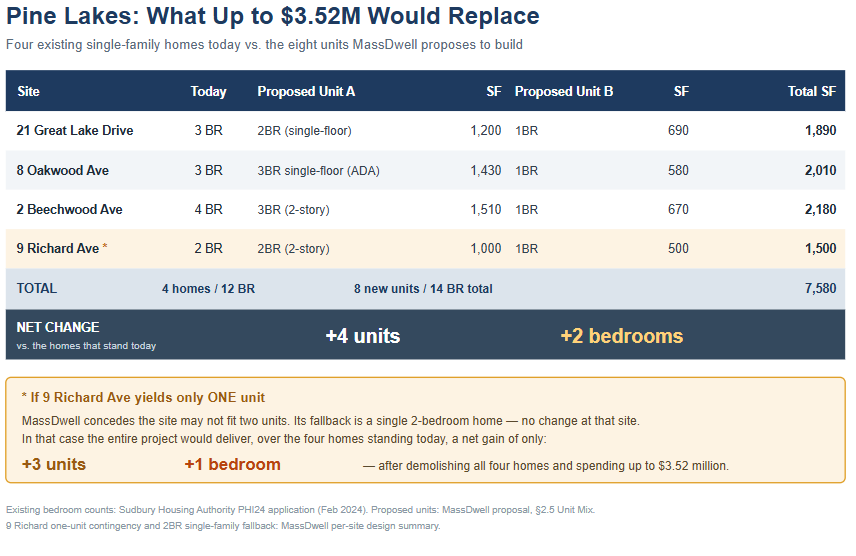
Should that occur at 9 Richard Ave as the developer outlines and this project yields13 bedrooms, the math becomes hard to defend: a roughly $3.52 million project would, after demolishing four existing homes with 12 bedrooms, deliver a net gain of essentially one additional bedroom over what stands today. And here is the contradiction at the center of it all: the Authority spent years justifying this project by citing demand for 2-bedroom units, yet the plan it is now advancing delivers four small 1-bedroom accessory units.
This is the heart of the concern, and it is about process as much as price. When a town says no through every channel it has — its elected boards, its Finance Committee, its housing survey, and a direct Town Meeting vote that put $500,000 behind the opposite course — the appropriate response is not to find a route that asks residents less, not more. Public housing is built with public money, and public money carries a duty of public accountability.
The case raised is not anti-housing, and it never has been. Sudbury’s subsidized housing stock continues near 12%, above the state’s 10% threshold. Residents have repeatedly said they would actively support new affordable housing at more suitable sites. The objection is to one specific plan on these specific small lots — and the town’s own data backs them up with the FlashVote housing survey.
None of this requires anyone to be a villain. Reasonable people can want more housing and still conclude that demolishing scarce, repairable single-family homes is the wrong way to get it. Article 39 was written to respect the Authority’s autonomy — it is permissive, not a mandate. It simply offers a funded, lower-risk path to the shared goal of housing families, and it does so in line with what residents have said they want.
The honorable next step is straightforward: listen and pause the demolition track, accept the repair funding the town has already approved, and bring any revised plan back into the open for genuine public discussion.
Sudbury has been clear, consistent, and constructive for three years running. Its Housing Authority should meet that good faith with the same — working with residents, not around them at every step of the way.