


Share This Article
INTRODUCTION
An iron sculpture commissioned by the Friends of the Bruce Freeman Rail Trail has been completed.
The sculpture was fabricated by Walter Clark at the Stonybrook Fine Arts workshop in Jamaica Plain. It has been gifted to the Town of Sudbury as an artistic sculpture in iron to be installed along the Bruce Freeman Rail Trail.
BACKGROUND
As the railroad along the BFRT corridor was being dissembled in 2023, I picked up a few pieces of iron, not knowing exactly what they would be used for. I just thought the iron was interesting and could someday be repurposed or used to remind us a railroad ran there.
RAILROAD IRON USED IN THE SCULPTURE
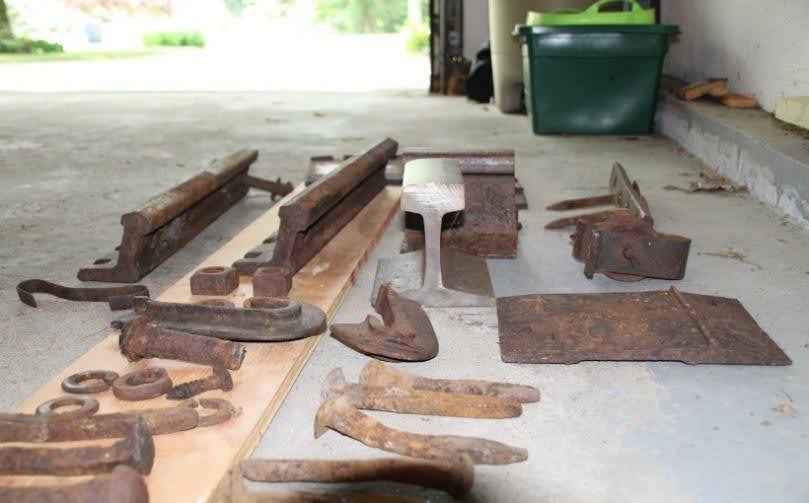

After looking at the iron pieces for a year it occurred to me that the iron could be made into a sculpture, a piece of art.
The hardest part of the project was finding an artist with the combination of talents needed to transform my verbal description and poorly drawn sketches into an expressive piece of art. It was a quest for an artist with an unusual combination of skills. It required incorporating irregular pieces of steel from the railroad as well as fabricating human and animal cutouts from sheet steel to be welded onto the framework. Lead after lead turned out to be unproductive. Six months into the search one of the leads suggested I try Stonybrook Fine Arts in Jamaica Plain, which is where I met Walter Clark and Kalamu Kieta. As Walter listened to my description, he had a puzzled look on his face. Then he smiled and said he had some ideas and thought he could do it.
I brought the pieces of iron that had been collected as the railroad was being dissembled to Walter and Kal at Stonybrook to see if they could be used it in the sculpture. Walter saw the iron, smiled, and said, ‘yes’, much of it could be used in the sculpture. Our discussions turned into a series of drawings which became the visual basis for the sculpture. At that point Walter said he would need a model to begin work on the full-size sculpture.
THE MODEL
The next time I went to Stonybrook, Walter showed me the model he had made.
He explained the final product would not exactly replicate the model, but he understood what I wanted, and the model was it.
OBJECTIVES OF THE SCULPTURE
The sculpture was created with these objectives in mind:
- To pay homage to the corridor as a railroad that carried passengers and freight from 1871 until 1933. Passenger service ended in 1933. Freight service continued until April 2000.
- To illustrate, through the figures on the railroad-track inspired arch, the corridor’s current uses for transportation, recreation, and exercise.
- To recognize the natural wildlife that did, and still does, inhabit the corridor and adjacent lands and ponds. The sculpture contains figures of a duck and a turtle.
WILDLIFE
These photos of ducks and turtles were taken from the rail trail, March 22, 2025.
CUTTING FOR RAILS
We needed some longer pieces of rail for the base of the sculpture. Last November two five-foot sections were cut from rails stored north of the rail trail.
HISTORY IN IRON
The rails have the manufacturer’s name and year of manufacture imprinted on the side. Some of the rails in the BFRT corridor were made by Bethlehem Steel in the first quarter of the 19th century.
SITE FOR THE SCULPTURE
The location selected for the sculpture is the recreation area adjacent to the new parking lot on Morse Road, next to the rail trail. At that location trail users will be able to see and access the sculpture directly from the Bruce Freeman Rail. The sculpture measures 87 inches across and 61 inches high. The base is 60 inches wide and 30 inches deep. The sculpture weighs about 1,100 pounds.
It contains pieces from the Lowell and Framingham Railroad that ran along the corridor that is now the Bruce Freeman Rail Trail including rails, plates that held the rails to the ties, railroad spikes, and connector bars that connected sections of rail to each other.
FABRICATION OF THE SCULPTURE
These photo albums illustrate the Bruce Freeman Rail Trail sculpture during fabrication by Walter Clark and Kal Kieta at Stonybrook.
LINKS
https://photos.app.goo.gl/tNKkEvphbNT2b7Bi9
https://photos.app.goo.gl/wsZLKkuUPktH2a4Z9
https://photos.app.goo.gl/Wd7WiAZBwintZxyw6
Below: Walter Clark in front of the completed sculpture, July 1, 2025. The figures on the arch were cut from steel plate and welded onto the frame.
A LEGACY AND HISTORY LESSON
Children who view the sculpture may ask about the rails and how the rail trail got its name. It is named in memory of Bruce Freeman, a state legislator who advocated for converting the abandoned railroad corridor into a trail trail. Perhaps that will inspire them to ask about why the railroad was there in the first place and learn about Sudbury’s growth and development for the past 150 years. It is a rich history, and one that binds us to the land.
VISION TO REALITY
Work on the sculpture began in August 2024. Over the next eleven months the sculpture morphed from a vision into reality. Walter modified the sculpture until it accomplished our goals, and unveiled a unified beauty of its own. As far as I know, there is nothing quite like it. Sudbury can be proud to be home to a unique piece of art, with deep local roots. The sculpture will add interest to the already popular trail.
THANKS TO THE FRIENDS OF THE BRUCE FREEMAN RAIL TRAIL AND TOWN MEETING
The Board of the Friends of the Bruce Freeman Rail Trail made the sculpture possible with generous funding, not knowing what the final product would look like. I would like to acknowledge their confidence, and express my deep gratitude to the Board of the Friends.
In 2022 Town Meeting appropriated funds that could be used to move the sculpture from Stonybrook to Sudbury and installation. I am indebted to the residents for their support of this project.
An interpretive panel describing the sculpture’s history and purposes will be located near the sculpture.
CONCLUSION
The sculpture project can be seen as a model for cooperation between a non-profit organization and a municipality, to produce tangible benefits to both. The ultimate test will be how the sculpture is received by the community.