



Share This Article
Overture, a company that partners with schools, after-school programs and youth centers to deliver paper and pencil courses that teach kids to build a sense of agency and thoughtfully direct AI as a tool, is coming to Sudbury. A new partnership with the Sudbury Park and Recreation Department will bring new programming to Sudbury students and families this fall. We caught up with Aspen Buckingham, co-founder and CEO of Overture, to learn more about their programs. Thanks to Aspen for taking the time!
You are launching your after-school program this September through a new partnership with the Sudbury Park and Recreation department. Can you tell us a bit about what you’re offering?
We’re bringing Overture’s paper-and-pencil AI literacy program to Sudbury this fall through a partnership with Sudbury Parks and Recreation, making Sudbury one of 18 Boston-area communities now offering the program. The after-school Intro to AI program runs Wednesdays from September 23 through November 18, and a family AI workshop is set for October 24.
Overture built its model around helping students think critically about AI. Students learn to direct AI as a tool, question it, and spot its mistakes, and they do it all without sitting in front of a screen. Students brainstorm ideas, write prompts by hand, and work in small groups. Then trained Overture instructors, many with Harvard Graduate School of Education or similar backgrounds, enter those prompts into AI tools to bring the students’ ideas to life as apps, videos, or interactive games. Over the 10-week program, students work in teams and typically progress from simple prompts to building an entire imaginary world or publishing a video game.
Out of the Boston-area communities you currently operate in, what makes Sudbury a great fit for your curriculum?
Parents and educators know AI is here to stay, but they don’t want children navigating a chatbot alone. Sudbury is a community that takes both education and its kids’ relationship with technology seriously. When David Crow saw we were offering AI classes he immediately applied to teach with us. David has joined our team and is a fellow technology business owner, an MIT graduate, a local Sudbury father and regularly coaches basketball at the Sudbury Recreation Department. Our model gives kids a safe, paper-and-pencil introduction to how these tools work and where they fall short, while keeping the technology itself in the hands of a trusted adult. That’s what makes communities like Sudbury and the Sudbury Recreation Department comfortable and excited to partner with us.
Overture’s model is highly unique because students learn to use AI without actually sitting in front of a screen. How did you discover that a “paper-and-pencil” method was the safest and most effective way to introduce this complex technology to young minds?
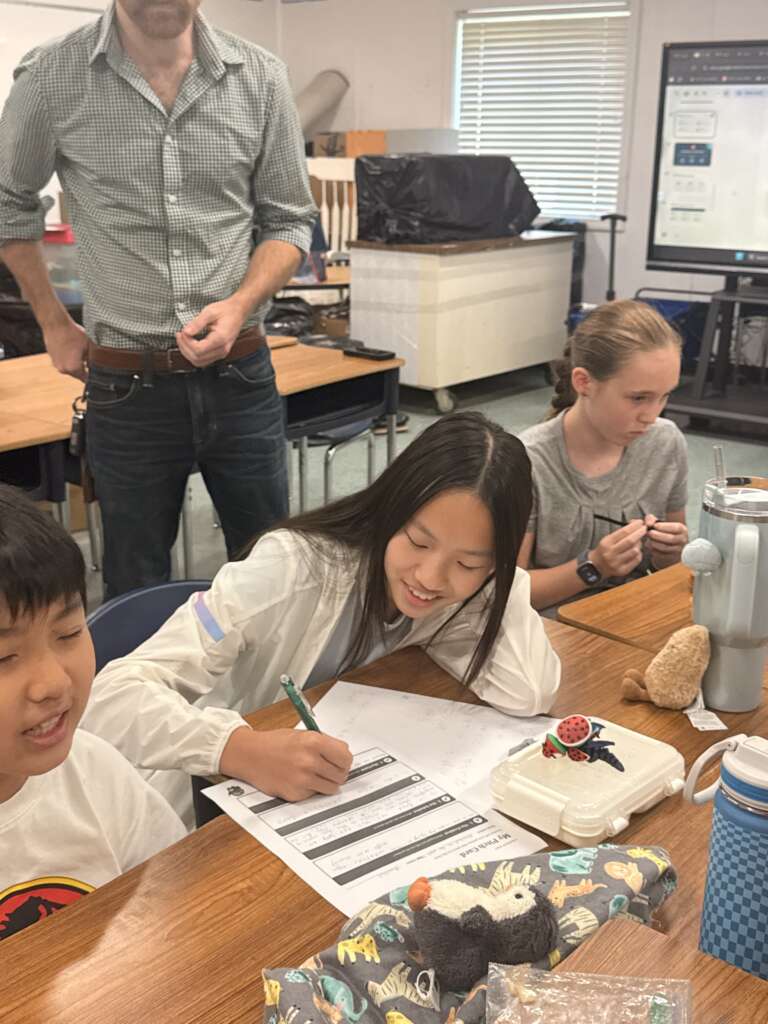
We built Overture because we kept hearing the same thing from schools: they know AI matters, but they don’t have a roadmap for teaching it to young kids responsibly. Parents and educators know AI is not going away and many students have access to AI tools like Google, YouTube and Alexa at home. As founders Steven and I taught hundreds of classes ourselves and saw first hand the improvement of skill development when students were taught in-person with paper and pencil as opposed to relying on 1:1 screen time. We designed a model where the students do the thinking, the brainstorming, the prompt-writing, and the collaborating by hand, and a trained instructor is the one who enters those prompts into the AI tools. Kids get a real, hands-on understanding of how these tools work and where they fall short, while the technology itself stays in the hands of a trusted adult.
Your materials highlight a gap in AI education for elementary and middle school students compared to high schoolers. Why is it so critical to intervene and help form healthy tech habits during these younger years?
Elementary and middle schools introduce AI far less often than high schools, leaving a gap in the years when kids’ habits with new technology are forming. By the time students reach high school, many have already been using the internet and tools like AI on their own for years. Reaching students earlier means they learn to direct AI as a tool, question it, and spot its mistakes before the habits are ingrained.
One of your classroom activities, “Real or AI,” teaches kids to identify the telltale signs of AI-generated images. As models evolve, the “tells” can become harder to spot, and new “tells” often emerge. How do you keep the curriculum up-to-date with model evolution happening at breakneck speed?
We’ve all been sent that video from grandma of tigers jumping on a trampoline… Kids around nine and ten and even adults are asking what’s real and what isn’t, and “Real or AI” aims to help develop a healthy skepticism of generative AI and online content. It’s one of our most popular activities, but it isn’t really about memorizing a list of tells. Real or AI helps build the instinct to pause before you believe something, ask where it came from, check your sources, and understand that “it looks real” isn’t proof. Students love the moment they look closer and catch something they almost missed, and they go home and show their parents, which is an important conversation most families want to have but often don’t know how to start. That instinct gets more valuable every year as AI improves, and it’s the kind of healthy skepticism we want students carrying into what they see online.
Many parents are understandably anxious about their children navigating a chatbot alone. What can Sudbury parents expect to experience and learn at the upcoming family AI workshop on October 24?
The workshop is built to help with that overwhelming feeling AI can bring. Instead of us explaining AI to parents, families experience the same paper-and-pencil approach we use in class: brainstorming an idea together, writing the prompt by hand, and watching an instructor turn it into something real with an AI tool. Seeing the process end to end is what takes the mystery out of it. Parents leave knowing what these tools are good at, where they get things wrong, and how to talk with their kids about using them thoughtfully, and kids leave having built something together with their family.
The technology industry has been telling people in the workforce that AI won’t replace workers, so long as they learn how to use AI. Meanwhile, studies funded by some of those same companies have indicated that workers who heavily use AI do less deep and critical thinking. How do you help students develop a healthy understanding of the role of AI in their lives as students, and potentially in their future careers?
One risk is that students use AI to outsource their own thinking. At Overture students decide what to build, develop their ideas, and write their prompts (in complete sentences!) before we introduce AI tools. Then students evaluate what AI comes back with, and a lot of the time it’s wrong or not what they meant. Students develop their own creative taste and the AI is just a tool they’re directing. This habit is one we want them to carry into school and eventually work. Students with these habits will get more out of AI than someone who leans on it, and they’ll know when to avoid using AI as well.
You have explicitly stated that your goal isn’t to create overnight AI experts, but to build confidence and judgment. How do you envision these foundational skills serving Sudbury students as they transition into high school and the modern workforce?
Our goal is to help students develop the judgment to use these tools well, and the confidence to question what AI gets wrong. The specific tools will keep changing, but the habits of treating AI as a tool and having a healthy skepticism for what it can and can’t do won’t go out of date. A student who has learned to build an entire imaginary world or publish a video game by thinking through the ideas themselves first will walk into high school, and eventually the workforce, with a strong sense of agency over technology.
[Editor’s Note: Registration is on the Park and Recreation programs page here.]