



Share This Article
Editor’s Note: The Edmund Rice (1638) Association, Inc. is one of the oldest family associations in the country, tracing its roots back to Edmund Rice, who arrived in the Massachusetts Bay Colony in 1638 and helped settle Sudbury. For nearly a century, the group has gathered for an annual reunion, bringing together descendants to celebrate their shared heritage and preserve the story of one of the town’s founding families. John Chandler, president of the Edmund Rice Association, was kind enough to answer our questions.
The Edmund Rice Association has been active for more than a century. What does it mean to bring the 2025 reunion back to Sudbury, where Edmund Rice first settled in the 1630s?
As a matter of fact, our reunions are generally held not far away from Sudbury — in the last 30 years we have met here six times, more than any other location. The roster of other places includes Lexington, Concord, Wayland, Framingham, Natick, Marlborough, Northborough,Barre, Worcester, Sturbridge, and Westborough; we met once as far away as Salt Lake City. The attraction of Sudbury is, in part, the occasion of getting back to our roots.
Reunions have been happening since 1851. How has the tradition evolved over time, and what remains at the heart of these gatherings?
The early reunions were always held at the old homestead by the “neverending spring” (which was still occupied by Rices in those days). We don’t have detailed records of those early meetings, but they were undoubtedly informal gatherings of one afternoon, or perhaps a whole day. Things got more serious when the old Rice house burned down (around 1910), and a formal Edmund Rice Association (ERA) was created with the initial goal of raising funds to erect two monuments to Edmund Rice. Still, the reunions continued to be social events, sometimes highlighted by pageants celebrating Edmund’s life. As time went on, the meetings grew more serious and included historical and cultural presentations on the life and times of Edmund and his descendants. Even so, the main point of these reunions remains social: the gathering together of an extended family.
Genealogy is at the center of your mission. How are modern tools like genetic testing and digital archives changing the way you document and connect Edmund Rice’s descendants?
We jumped onto the genetic bandwagon as soon as it became available. Because Edmund had seven sons who grew up and had descendants of their own down to the present day, we had the prospect of analyzing and comparing the Y-DNA of the seven clans. Since the Y chromosome is passed almost unchanged from father to son down the generations, we were able to ascertain the inherited ancestral Y pattern of Edmund and get an independent check on the patrilineal ancestry of modern-day Rices. Of course, the ERA is not restricted to male-line descendants of Edmund, and so this DNA test is applicable to only a tiny fraction of the potential membership, but, even so, it has revealed genealogical errors on more than one occasion. As for the availability of on-line record archives, that has revolutionized the collection of family data by allowing 24/7 access to (images of) the original records.
The Association has supported research and made grants in Sudbury and Marlborough over the years. Can you share some examples of local projects that have benefited from your efforts?
The earliest formal activity of the association was the raising of funds for erecting monuments. One was a cenotaph in the North Cemetery in Wayland, and the other a historic marker by the roadside on the Old Connecticut Path, up the hill from the old homesite. In more recent times, we have collected and published genealogies of Edmund Rice descendants and donated copies of these books to various libraries. We also donated an archive of other genealogical materials to the Goodnow Library here in Sudbury. On a more mundane level, we contributed financially to the refurbishment of the Marlborough Historical Society.
What role do your newsletters and publications play in keeping the community of descendants connected throughout the year?
The newsletters provide a medium for family news ranging from birth notices to obituaries, and also an avenue for research queries (and, with luck, answers to queries). New members who already know their lineage back to Edmund, or who discover it after joining, often send it in for publication in the newsletter. Needless to say, the published books are not infallible, but they provide a good starting point for individual research.
This year’s reunion includes visits to historic sites and a lecture. What are some highlights attendees can look forward to in 2025?
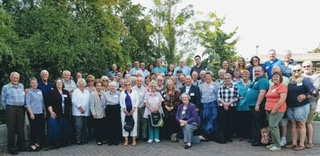
The reunion will kick off on Friday September 26th with a bus tour that will include, among other things, visits to both of the monuments mentioned above, as well as a visit to the Sudbury Historical Society Museum. After that will be a social hour and dinner at the historic Wayside Inn. Saturday will include several presentations, beginning with one that we like to call “Edmund 101” — a summary of what is known about our ancestor. After lunch, guest speaker Jane Sciacca will give a talk about the role of the Rice family in the Revolutionary War. It should be noted that we do not require members to prove their descent from Edmund Rice, and we welcome attendance at the reunion of all who even think they might be descendants. Details can be found on our website (edmund-rice.org).
The database of Edmund Rice descendants is a major undertaking. How do you ensure accuracy and credibility in an age where so much genealogical information online can be unreliable?
No genealogical work is ever entirely free from errors. The database has an important advantage over hard-copy books, for errors can be quickly and easily corrected whenever discovered. We encourage members and non-members alike to submit their family trees for inclusion in the database, and we impress upon them the need to cite primary sources wherever possible.
For newer generations of descendants, why is it valuable to stay connected to Edmund Rice’s story and the broader family network today?
We like to think that the ERA is more than just an association — it’s a family. We do tend to focus on the genealogical aspects, which young people often find tedious, but large-scale family feeling can certainly be a component in community building. On a more down-to-earth level, it’s a fact that young people grow older, and, when they do, they come to regret the questions they failed to ask their elders when they had the chance.