



Share This Article
On Tuesday, September 9, the Sudbury Select Board voted to instruct Town Manager Andy Sheehan to review the Town’s current agreement with a private camp operator at Camp Sewataro and return to the board with options, information, and recommendations for how to proceed in the future.
Member Charlie Russo, who negotiated the terms of the current agreement with the camp operator, defended the overall approach to the license agreement. He cited that the latest agreement increased the rent paid by the camp operator to match what the Town used to generate in property tax revenue when it was privately owned.
“In the second round the goal was, let’s get the guaranteed revenue to be equivalent to what the property taxes were, roughly. They’re paying roughly $200,000 in property taxes at the time. Let’s get the base payment closer to the, the equivalent of that, and then the revenue share on top. And then, you know, there was the ADA improvements that we asked for, and if the Town just managed it on its own, probably none of those would have happened. So that access that’s there now probably wouldn’t be there.”
Member Dan Carty, along with Russo, pushed the board to get more specific about the instructions being provided to Town Manager Andy Sheehan. In response, Chair Lisa Kouchakdjian gave an example of what she wanted the professional staff to evaluate. Kouchakdjian pointed out that she wanted to understand the pros and cons of a license agreement versus a triple-net lease.
So I was the one negotiating this original deal with the camp operator, and all this stuff came up, and we picked the reason that we did for reasons, okay?
While the legal distinctions between the two are significant, there’s one major distinction: The current agreement is labeled as a license agreement, which does not require the approval of Town Meeting. A lease would likely have to go before Town Meeting for a vote.
Member Carty told Kouchakdjian “I don’t think it ranks super high on the important things that the Town Manager should be doing right now, but if it’s current agreement versus triple net lease, we’re gonna find that we had all these discussions years ago when this was originally haggled. I was in the room, Lisa, you weren’t, right? So I was the one negotiating this original deal with the camp operator, and all this stuff came up, and we picked the reason that we did for reasons, okay? So if we want to go and revisit all down and over again, fine.”
Vice-Chair Dretler and Member Carty got into an exchange about the original contract negotiations:
Dretler: “Yeah, I was there then, too, but…”
Carty: “You were not in the room!”
Dretler: “Yeah, no, absolutely, I was not in the room, so I was not privy to those discussions, because those were not brought back to the board. Absolutely correct. But I do think that it is time to look to staff, which we have not had since we acquired this property, to get more professional assistance in whatever comes. I’m not saying, you know, here’s my idea, this idea, I’d like to hear from staff first.”
The exchange highlighted one of the stranger aspects of Sudbury’s Camp Sewataro: it has been six years since the acquisition and the Town has never developed a long-term plan for the property, nor has it studied the various potential uses for the property.
Jump to 2:11:25 to watch the discussion below:
What’s The Plan?
The absence of a long-term plan for Sewataro is highly unusual for two key reasons. The first is the nature of the property, which includes multiple single-family homes that may only be offered to camp employees rent-free as a benefit of employment, man-made bodies of water, septic systems, and a variety of other structures and sport courts.
Unlike an open space acquisition which is typically done to keep unaltered land unaltered, there is significant infrastructure and a multitude of facilities on the heavily-altered property. That makes it far more complex and far more suitable for a site-specific long-term plan.
The second reason is simple: the “lease camp” option was explicitly presented as a means to buy time for long-term planning. In fact, the 2019 Town Meeting presentation by then-Town Manager Melissa Rodriguez specifically stated that the option to lease/license to a camp operator would provide time for the Town to develop a long-term plan.
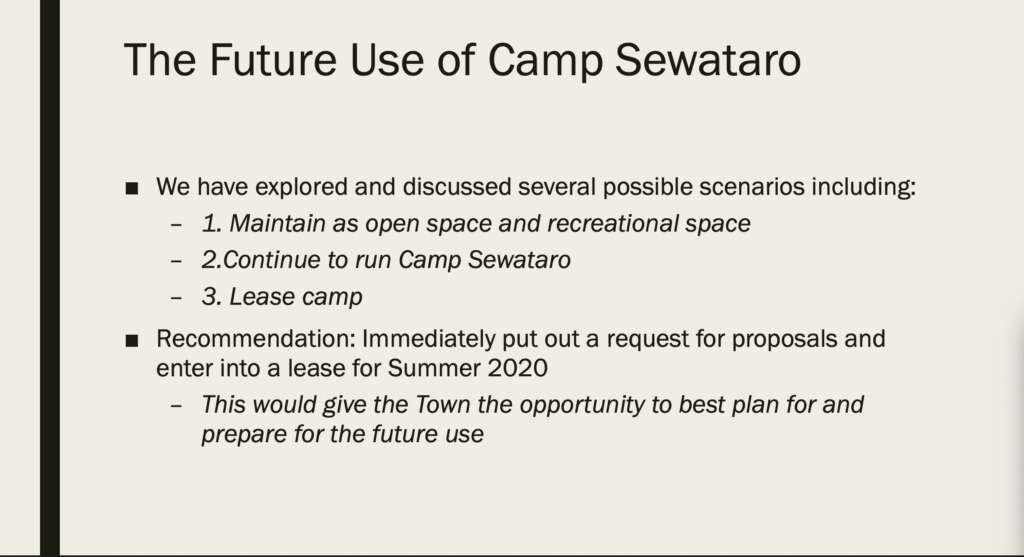
The Select Board did attempt to get Town Meeting to fund a land use study several years later, during the 2022 Annual Town Meeting. The article failed at Town Meeting, but the contract had already been extended five more years before residents had an opportunity to vote on the land use study. In other words: the Select Board locked in over half of a decade of the “lease camp” approach before Town Meeting had an opportunity to appropriate funds for a long-term planning exercise. (The extension was executed on April 12, 2022 – a few weeks before the 2022 Annual Town Meeting)
Is The Status Quo Working?
The agreement has produced approximately $200,000 in rent and just shy of $100,000 in revenue sharing per year since the contract was extended. The annual debt payments for the land acquisition have been north of $700,000 during that time. (2023 Financials, 2024 Financials)
Member Russo pointed out that basic maintenance costs for the property, which were originally estimated at around $150,000 per year, were also shifted onto the camp operator and off of the Town’s books by way of the current agreement. However, the maintenance costs incurred by the camp operator do impact the final revenue share that the Town receives.
In addition to the revenue-generating features of the current agreement, the camp operator has made investments into property upgrades, including accessibility enhancements. The operator has launched a resident swim program for the past two summers. Blue-green algae interrupted the swim program both years, but the disruption in summer 2025 was nowhere near as impactful as 2024.
Proponents of the current agreement point to the balance of revenue generation, resident access, and reduced maintenance/property management burden on the Town. Some residents have voiced appreciation for the continued operation of the private summer camp, which has a long history in Sudbury.
Critics of the agreement often point to the limits on resident access during the most desirable summer months. When the camp is in session, the property is closed to the public. Outside of camp hours, residents still do not have full access to the property. Insofar as taxpayers foot the bill for the $12M acquisition, losing summertime access just for the Town to generate about $300,000 in revenue from the camp doesn’t sit well with some residents.
In short, perspectives on the current arrangement are varied and, to a large degree, subjective due to the complexities of the property and the license agreement.
Next Steps
While Member Russo expressed that he felt this review was “premature” because there are still a couple years left to go on the current agreement, Chair Kouchakdjian told the board that she expected the review to take a considerable amount of time. Vice-Chair Dretler voiced a desire to stay ahead of some of the provisions in the contract for renewal discussions, particularly because the board had to rush to complete the last contract extension.
Town Manager Sheehan will likely come back to the board in the future with initial findings, but a specific timeline was not established.