



Share This Article
Lincoln-Sudbury Regional High School (LSRHS) is faring rather well in school rankings, so far, this year. But educators, including LSRHS Superintendent Andrew Stephens, often point out that rankings don’t capture the full picture of what’s happening in high schools.
One oft-cited example is the LSRHS “Program of Studies.” The Program of Studies is the typical means by which secondary schools meet a requirement in Massachusetts to clearly communicate academic offerings and graduation requirements. But does that make it easier to compare one district to the next?
For the sake of a high-level comparison, Sudbury Weekly reviewed the Programs of Studies from LSRHS, Acton-Boxborough Regional High School and Wayland High School. Readers might be surprised at how much variation can be found from one high school to the next. While it’s impossible to construct a perfectly-balanced comparison from one school to the next, it was relatively easy to spot major differences in philosophy and differences in the areas of emphasis in a given area of study.
One such example is in the grade-limited course offerings. LSRHS eschews this traditional approach for the bulk of its academic offerings. Acton-Boxborough and Wayland generally adhere to the grade-limited approach with a handful of exceptions and varying levels of electives being offered in different subjects.
The English programs at the three schools exemplify these differences.
English
The graduation requirements vary significantly from one school to the next, and the degree to which students have choice within a given subject of study varies greatly. For example, Acton-Boxborough students must complete a four-year core program in English, and recommendations for course placement are made by teachers.
At LSRHS, course placement within the English Department is based upon “student interest and need, teacher recommendation, parent approval, and scheduling availability.” The LSRHS English program also maximizes student choice: “All courses, with the exception of Ninth Grade Composition and Literature, are open to grades 10-12.”
The differences don’t stop there. The Acton-Boxborough Program of Studies lists 11 English courses available to students in total. The LSRHS Program of Studies lists seven English courses in the “Writing and Skills” category of the English Department, and another 27 in the “Literature” category. Importantly, not all courses are offered every year or semester, and others are being phased out.
Grade 10 students at Acton-Boxborough will take English II — which describes itself as “In this survey of American literature, students read works representative of the diverse voices that comprise our country in three broad thematic units–identity, diversity, and justice and action. In this course, students study the craft of writing by reading varied genres including the novel, narrative nonfiction, memoir, poetry, drama, and short fiction.”
In contrast to that approach, most grade 10 students at LSRHS can pick from roughly three-dozen English courses ranging from Creative Writing to Analysis of Literature and Film, the Making and Remaking of Race, two Shakespeare offerings, multiple British Literature offerings, and six American Literature courses. Additional courses include Detective Fiction, Heroes in Literature, A Literature of Chaos, Ideas In Drama, and Biblical & Classical Literature, many of which meet the Global Scholar designation, and/or are offered in both Honors and High Honors levels. (Pages 18 through 25)
Seniors at Acton-Boxborough get access to a handful of theme-based English courses, including The Blurring of Fantasy and Reality: The Study of the World Around Us Through Speculative Fiction, Art of Truth: Exploring and Experimenting with Stories Across Genres, and Our Shared Humanity: The Literature of What Unites and Divides Us. In total, there are five grade-12 English courses offered at Acton-Boxborough. (Pages 15-19)
Wayland High School follows a similar approach to Acton-Boxborough, breaking out English offerings by grade, then increasing the variety and electives for seniors, particularly for those seeking honors or college-level courses.
History
LSRHS students are required to attain 12 credits in History and the Social Sciences, including four in American History. The course offerings reflect a uniqueness and variety, once again, that isn’t quite comparable to other high schools. Within American History alone, there are ten courses offered, including uncommon courses like Sports in American Society and History of Food in America. More traditional offerings are required to meet the U.S. History requirement, but the electives stand out.
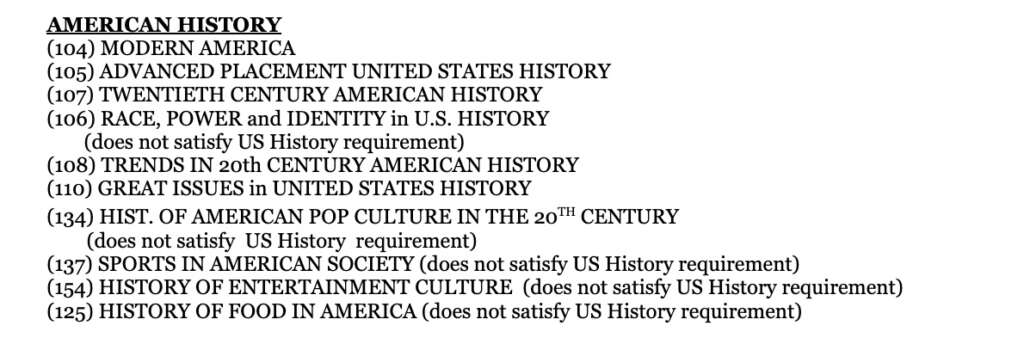
Students at Acton-Boxborough have different requirements to start “All students are required to take three years of social studies, with the core program consisting of World History, United States History and Government I, and United States History and Government II.” The offerings are not limited to sequential, grade-limited offerings to quite the same degree as their English program, but availability is still based upon grade for certain requirements. Much like LSRHS, electives are available covering psychology, the law, economics and global conflict.
Wayland High School appears to take a similar approach to Acton-Boxborough “Students must complete three years of social studies to meet the graduation requirements of Wayland High School, which must include the two- year United States history sequence (10th grade US History I and 11th grade US History II).” (Page 40)
Notably, the Wayland program combines Social Studies with “Business and Innovation.” While the base requirements for graduation are fairly traditional offerings, with an emphasis on U.S. History, the electives include three courses within the Business category, and a Makerspace & Innovation Career Pathway focused on giving students coursework and experience in a “high demand industry.” LSRHS offers a dedicated Career Exploration Program with a variety of offerings, while Wayland High School appears to have more of a hybrid of the Makerspace & Innovation Career Pathway and work study/internship options in their “Additional Courses and Supports” category.
LSRHS appears to differentiate with courses that, while they may sound like traditional history courses, have become the stuff of legend within the school. Many of those courses are categorized as European Studies, Area Studies and Social Sciences. For example, World Crises In Historical Perspective is a popular Area Studies course that self-describes as follows: “In the first semester, World Crises students learn basics about the history of the international system and international relations theory, then examine foreign policy crises of the 20th century in order to glean historical lessons from those situations. Equipped with those lessons, in the second semester students use history as a tool to analyze current foreign policy issues and work to craft their own policy suggestions and to evaluate policy makers’ efforts.”
Once again, LSRHS is unique in the absence of a grade-specific requirement and the abundance of student choice in this subject.
Math and Science
Math programs tend to be more similar than programs in the humanities, in part because the courses build upon each other, or have key prerequisite courses. LSRHS and Wayland both offer sequential pathways in math that are tailored to the students abilities and prior performance.

Acton-Boxborough covers many of the same subjects across similar-sounding courses, but describes a collaborative process between teachers, parents and students for placement in a given course. “When making course selections, student’s should keep in mind that teachers make recommendations on a variety of factors to place students in the class that will best strengthen the individual student’s understanding of math. We encourage families to collaborate with their students’ classroom teachers so we can best develop the student’s mathematical understanding, enjoyment of the subject, and self-confidence as a learner.” (Page 29)
Things are similarly sequential across the three high school science departments. LSRHS starts grade nine with Earth Science, then it’s Biology for grade ten, chemistry for grade 11 and physics for grade 12. Wayland High School starts with biology then goes to chemistry, physics, and electives/AP’s for seniors. Teacher recommendations seem to dictate the science course sequence for Acton-Boxborough students, but their Program of Studies generally puts emphasis on Environmental Science for grade 9, then biology, chemistry and physics, with higher level versions available based on prerequisites and teacher recommendations.
LSRHS once again stands out for its unique elective courses, including Science of Disasters, Science of Survival, and Science and Film. The school also offers courses in forensics, aquatic biology and anatomy, which were also offered at the other schools. Another area where LSRHS was unique was the clear communication of the sequencing. (Pictured right.)
Fine, Applied and Technical Arts
It’s difficult to compare the three high school art programs, largely because they categorize them differently. What LSRHS calls “Fine, Applied and Technical Arts” (FATA), Acton-Boxborough breaks out into separate Performing Arts, Visual Arts, and Communication Arts categories. Meanwhile, Wayland High School offers Fine Arts and Media as two categories. And so on and so forth. LSRHS stands out for its six full pages of music ensembles, courses and electives. That’s in addition to three levels of metalsmithing, three levels of ceramics, two photography courses, and yet another three courses in drawing/painting and three levels in woodworking. (Page 26)
Where LSRHS is matched in breadth of offerings in a given category of arts, it tends to offer more depth with sequential courses or advanced courses. Though all three districts offer coursework that is impressive, it’s once again unique that LSRHS seems to do this across all areas of study.
Computer Science
Yet another area of distinction: while Wayland and Acton-Boxborough offer Computer Science within their Math departments, LSRHS has a standalone Computer Science Department. The course offerings are fairly similar between LSRHS and Wayland High School, with Acton-Boxborough providing a more limited set of courses within their Math department.
The Bottom Line
Comparing Programs of Studies is difficult, if not impossible. Above is a cursory comparison of just the major areas of study where the most credits were required for graduation or the most courses were offered, and only across three high schools. There’s much more to explore in each school’s Program of Studies including Wellness, World Language, student programs and supports, Special Education, extracurriculars and community service requirements. Just like school rankings, the act of comparing schools is inherently problematic.
Unlike school rankings, the Program of Studies will show families if there’s a viable way to tailor the academic journey to the needs and interests of a given student. That utility could be worth its weight in gold compared to median scores on standardized tests.
One thing is clear: Lincoln-Sudbury Regional High School differentiates itself in terms of the sheer volume of student choice built into the program. Even in departments that need to provide sequential course offerings, the electives are robust, unique, and accessible to most students regardless of grade or teacher recommendations. LSRHS offers a breadth of courses across all departments that is hard to find elsewhere, particularly in a school of its size. In theory, that unlocks a greater variety of academic journeys.
Peers in the comparison districts offered their own flavor of depth and breadth, with one key distinction: the teachers and administration play a much larger role in course placement across departments.
Where LSRHS offers incredibly unique or exceptionally rigorous electives, other high schools sometimes offer a few more sections of Advanced Placement (AP) courses. In fact, that came up in 2024. At the time, Leslie Patterson, the Director of Curriculum, Instruction and Assessment at Lincoln-Sudbury, told the LSRHS School Committee regarding the complex demands of the scheduling process at LSRHS:
“So this process is extremely time consuming and complicated because we offer such a breadth of course offerings at L-S. And that’s really an amazing thing that happens at L-S, that we allow for student choice, that we have these rich electives in english and history, math and science for our seniors. We allow double enrollments, we have students who are teaching assistants, a strong arts department, so scheduling is not easy. If we were a school that just had English 9, English 10, English 11, English 12, it would be no problem at all to schedule. And I’m glad that we are not that school.”
That’s a nuanced point that really hits home once you’ve read the Program of Studies from LSRHS and those of its peer schools. These documents prove that no comparison is truly “apples to apples,” but they offer far greater insight into the educational experiences available to students than any ranking service seems to consider. Below are the links to the three referenced Programs of Study:
Lincoln-Sudbury Regional High School Program of Studies