
Share This Article
The Sudbury Public Schools (SPS) school district has issued a request for proposals (RFP) for after-school care in the school buildings. Meanwhile, the Sudbury Park and Recreation Department is slated to present concepts for collaboration with SPS at the March 2 meeting of the school committee.
With regard to the RFP, the district is required to put the contract out to bid as the prior contract approaches the end of its term to comply with State procurement laws. That makes this a fairly routine endeavor, but the district’s existing vendor, Sudbury Extended Day (SED), is sounding an alarm that it hasn’t in the past.
Late last week SED posted to their Facebook page calling for community members to contact the SPS School Committee and voice support for SED in the competitive bid process.
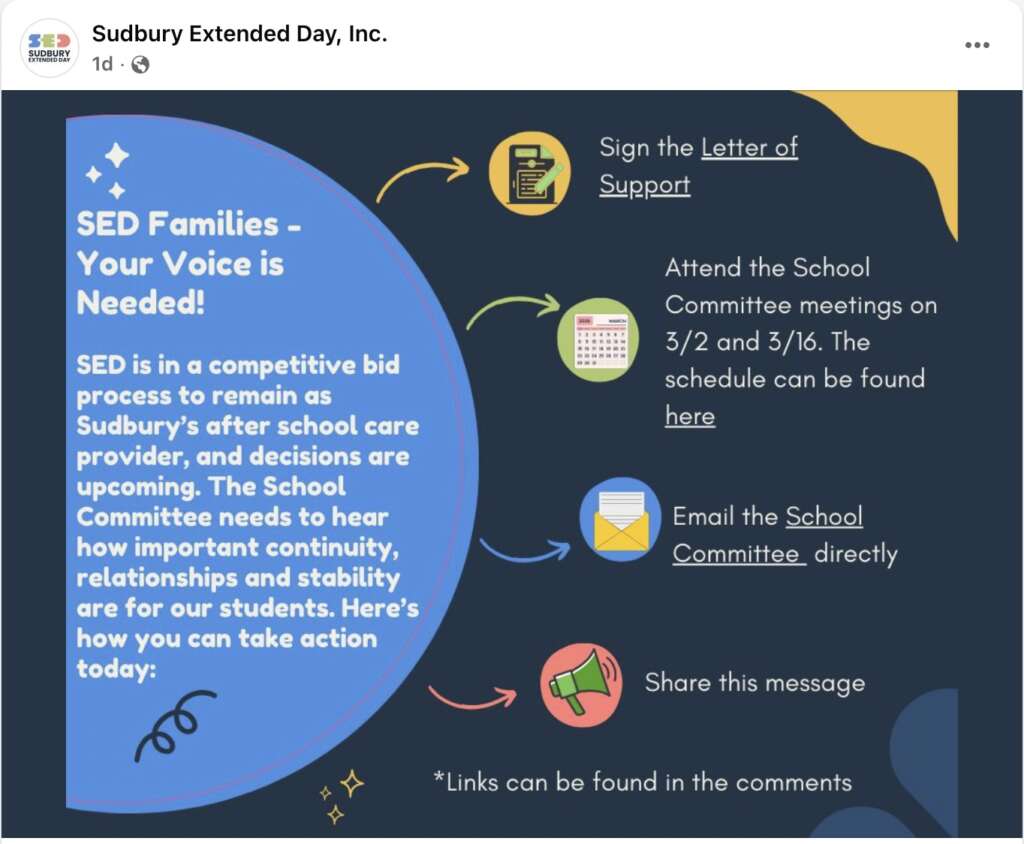
[Editor’s Note: An earlier version of this story embedded the SED Facebook post using the Facebook iFrame. That SED post has since been deleted so Sudbury Weekly uploaded a screenshot instead.]
SED also shared a link to a petition for community members to sign. (Petition here.) That petition launches with a clear call to action “We, the undersigned families and supporters of Sudbury Extended Day, are writing to express our strong support for the SED program and our deep desire for its continued stability and continuity. We also write to share our serious concerns regarding any potential changes that could disrupt the program, the long-standing relationships between SED and our families, or the model of care that so many families rely on.”
[Editor’s Note: An earlier version of this story linked to the petition, but that petition is not longer online.]
And the petition concludes “We respectfully ask that the School Committee recognize the overwhelming public support for this program and act in a way that ensures SED can continue serving children with the same excellence and care that it always has.”
Any effort by a bidder to apply pressure on a school committee or a selection/evaluation committee during a competitive bid process governed by State law is a potentially risky endeavor. Chapter 30B of the Massachusetts General Laws (the Uniform Procurement Act) is designed to ensure a fair and competitive procurement process. When bidders, particularly if they are an incumbent service provider, organize efforts to influence the decision making process, it could increase risk of a bid protest from other bidders or concerned parties. Public input on the decision is fair game, but things can get more complicated when a bidder is organizing the effort while the RFP process is still underway.
The evaluation and scoring of the bids is required to follow an objective process utilizing the criteria outlined in the RFP. That, in theory, creates a level playing field for all parties. Favoring the “continuity” that can only be provided by the incumbent vendor could be perceived as an anticompetitive, while the SED request in and of itself could put the district’s procurement process under scrutiny from other bidders.
Sudbury is no stranger to this scenario. The Town issued a cease and desist letter when the prior operator of Camp Sewataro encouraged camp families to support a particular bidder for the camp operator contract in 2019. In that case the recommendation for a particular bidder was already determined — but the Town still issued the cease and desist letter — demonstrating how municipalities take no chances with the integrity of the procurement process and adherence to State laws. The August 20, 2019 meeting minutes from the Sudbury Select Board noted:
“Providing additional detail, Town Manager Rodrigues stated on August 13th, the Town received notification that Camp Sewataro sent an e-mail to campers’ families (without notification or approval of the Town) regarding the RFP process and supported one respondent. In response to that action, the Town issued a cease and desist letter to Camp Sewataro asking that they issue no further correspondence regarding the RFP process. She emphasized that by that point, the entire RFP process had been completed and her non-public recommendation had been made five days before the occurrence. Town Manager Rodrigues stated that all Camp Sewataro information can be found on the Town website.”
While SED has called for community members to make public comment at the March 2 meeting of the SPS School Committee, that night the committee will also hear a presentation from the Sudbury Park and Recreation department on “after-school programming models and opportunities for collaboration between Parks and Recreation and the school district.”
Sudbury’s existing after-school programming does not have the capacity to accept all students, creating a waiting list and demand for alternatives or supplemental programs that have been discussed at length in recent years.
As a result of SED’s efforts to influence the decision making, the district may need to proceed with extreme caution to ensure the integrity and fairness of the process for all qualified bids. Meanwhile, discussion of collaboration with the Sudbury Park and Recreation Department will likely remain tentative until there’s more clarity about the future of the primary after-school program in the schools.