Share This Article
Town Manager Andy Sheehan has created a Budget Working Group just as the Fiscal Year 2028 (FY28) budget building process has commenced. The group will be discussing a forecasted deficit in FY28 and beyond, among many other considerations.
The first meeting was a bit of a primer on the latest budget forecast, and an update on the November 2025 presentation of the financial condition of the Town.
Assistant Town Manager and Finance Director Victor Garofalo provided a detailed overview of the budget forecast, and Town Manager Andy Sheehan provided additional context. The discussion was noteworthy for a couple reasons.
A Forecasted Deficit Is An Estimate
Despite chatter around Town about a projected $3 million gap in the FY28 budget, Garofalo made it clear that the real gap was somewhere between $1 million and $3 million — a $2 million spread.
“So you can see there at the bottom in [FY28], we have a three million dollar deficit. Do I think it’s three million? No. Do I think it’s one million? No. I think it’s somewhere between one and three.” (57:12)
That uncertainty is not unusual, particularly this early in the budget building process.
A Forecasted Deficit Is Not A Fixed Number
Sheehan and Garofalo explained the budget building process, and how they are trying to get earlier estimates for things like new growth, which could substantially reduce or increase the forecasted $3M deficit in FY28. One of the challenges with municipal budgets is that the numbers evolve as the budget building process moves forward. The process started, according to Garofalo, with a meeting a week prior to the Budget Working Group meeting, during which staff discussed capital articles for FY28. (56:30)
Sometimes the evolution of the numbers helps, like when Eversource’s transmission line delivered a significant spike in new growth and helped the Town avoid an override in FY27, which starts on July 1. But the Town depends on outside groups to provide data, estimates, quotes and certifications along the way. Ironically, “fixed costs” like health insurance can grow dramatically year-over-year — and they’ve been rising faster than the Town can raise revenue due to Proposition 2 ½.
Sheehan told the group “Obviously if the number stays at three million, that’s a tough number to deal with.” He added “That’s a big hill to climb. If some things shake out and that comes down to a million, a million and a half, that gets a little bit less daunting and there may be things that we can do. And then we’ll have a little more information that hopefully gives us a bit of a view into [FY29] and [FY30]. And help us to know whether if we have a bridge, for instance, to get us over a bit of a hump, that we’re actually getting over the hump and we’re not just building a bigger hump for ourselves a year or two out. So it’s an ever-changing landscape.” (1:33:45)
The Bottom Line
While the conversation covered a lot of ground, much of it likely comes across as municipal minutiae to the average resident. Most simply want to know if there’s going to be an override next year. The simple answer is that the Town says it doesn’t yet know for certain, though the picture will become clearer each month as as the Town approaches Annual Town Meeting in May of 2027.
That said — the trappings of an incoming override request are all there. A Budget Working Group, expanded budget communications, and an avalanche of financial data. So what does that mean for the average resident?
In November of 2025 Sheehan presented what a $3 million override would look like for Sudbury residents. For the average residential bill, it’s an increase of roughly $460 per year, or $38 per month.
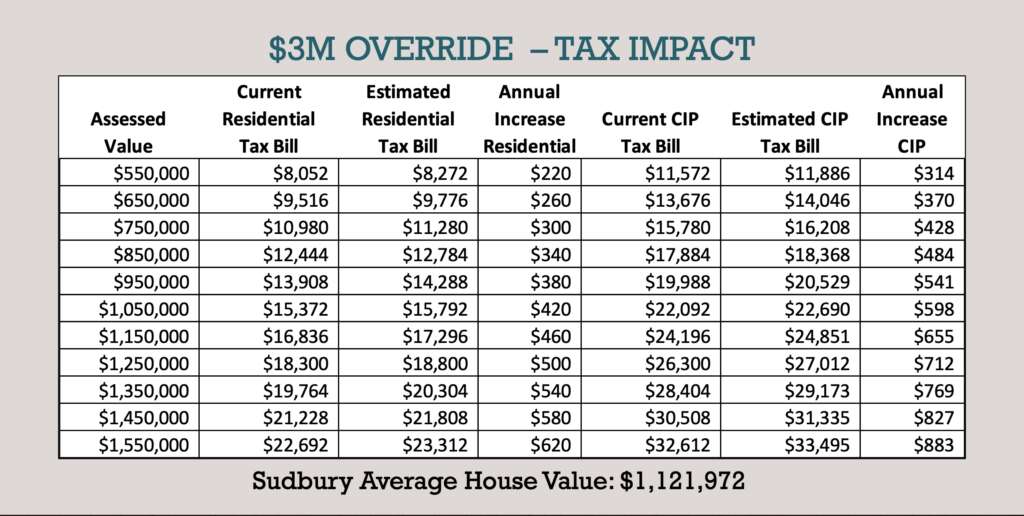
Again, a $3M override has not been proposed. The estimated deficit for FY28 is somewhere between $1M and $3M according to Garofalo. And that is subject to change as the numbers are developed. Further, Sheehan made it clear that any budget strategy would have to address multiple future fiscal years, not just FY28, in order to make sure a proposed solution is sustainable.
Digging Deeper
For all you municipal finance enthusiasts, a large portion of the meeting covered an updated Financial Report & Reference guide that provides a comparative analysis to other surrounding towns. That’s embedded below. If you want to play with numbers instead of reading about them, the Division of Local Services provides a tax impact calculator here.