


Share This Article
[Editor’s Note: this analysis utilizes data published by the Boston Globe. Sudbury’s school districts are expected conduct their own analysis and issue reports later this year.]
The 2026 Massachusetts Comprehensive Assessment System (MCAS) results were published for all districts in Massachusetts today, and the results reinforce ongoing concerns about English Language Arts across the state. A Boston Globe headline noted “MCAS results reveal ongoing decline in Massachusetts student achievement“. For reference, the Globe published a database here.
In Sudbury, the results generally followed the statewide trend. Here’s the raw data for SPS:
| SPS (% Meet or Exceed Expectations) | |||
| 2026 | 2025 | 2024 | |
| ELA | 67% | 71% | 65% |
| Math | 71% | 73% | 70% |
| Science/Tech/Engineering | 67% | 73% | 72% |
The 67% mark for ELA takes SPS students close to their lowest score on ELA since the pandemic, which was in 2024. The four-point drop across grades three through eight is not a massive decline, but it’s twice the statewide ELA decline cited in a press release issued by the Department of Elementary and Secondary Education today. “In English language arts, 40 percent of students in grades 3-8 met or exceeded expectations. Results declined by 2 percentage points from 2025. Grade 10 ELA also declined from last year.”
The grade-by-grade data for SPS shows an 11-point collapse for the fourth grade, a five-point drop for fifth grade, and a six-point drop for eighth grade.
Grades three and seven saw a two-point and three-point improvement respectively, but were the only grades to improve on the ELA section of the exams.
The more modest drop in math scores appears to be driven by grades three and eight, which dropped six points and five points respectively.
Science and Technology/Engineering pertains to grades five and eight only, with fifth graders dropping six points and eight graders dropping five points. The eighth grade scores have been declining in this area since 2022, when 79% met or exceeded expectations. In total, that’s a 12-point drop since 2022, whereas grade five students were on a three-year climb until reversing course this year.
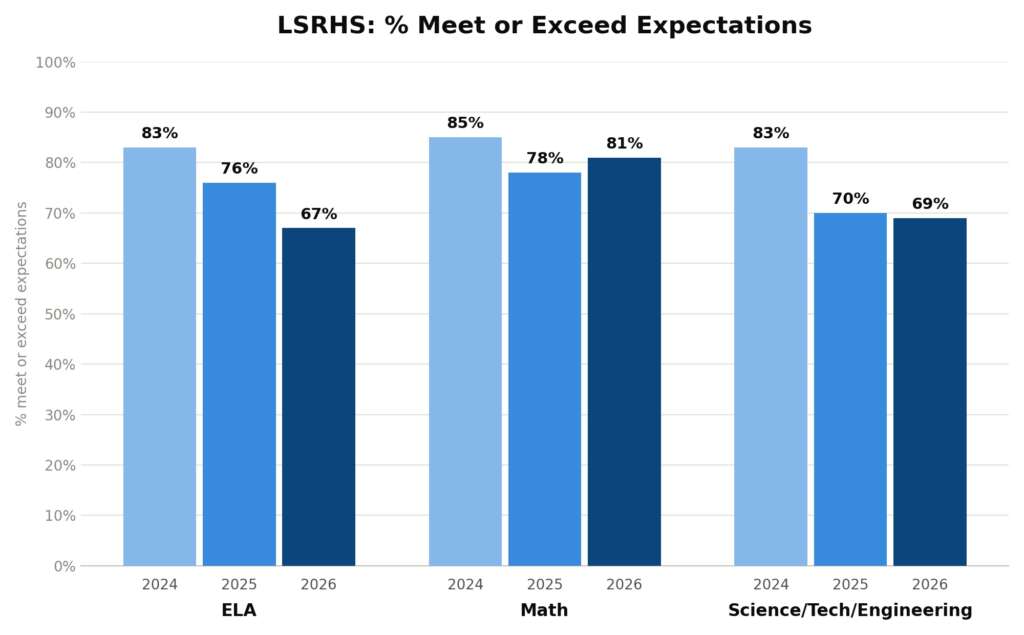
Over at Lincoln-Sudbury, the downward trend in ELA scores continued, while students showed improvements in math, and held mostly steady in Science and Technology/Engineering. Here’s the raw data:
| LSRHS (% Meet or Exceed Expectations) | |||
| 2026 | 2025 | 2024 | |
| ELA | 67% | 76% | 83% |
| Math | 81% | 78% | 85% |
| Science/Tech/Engineering | 69% | 70% | 83% |
The most noteworthy trend in the L-S data is, once again, ELA. Over the course of three years student scores plummeted 16 points. The 9-point drop from 2025 to 2026 mirrored the statewide results, but is nonetheless concerning given the pre-pandemic score was 86%. Some experts have speculated that some high school students don’t take the MCAS tests seriously anymore since they are no longer a graduation requirement. That might contribute to the trend, but it’s difficult to parse out cause and effect, and performance in other areas of the test indicate that L-S students are putting in a serious effort.
Math course-corrected and trended back towards its 2024 high point since the pandemic. Meanwhile Science and Technology/Engineering holds fairly steady following a precipitous drop between 2024 and 2025.
Curriculum Changes at SPS
The results for grades three through eight are noteworthy because the SPS administration rolled out a new ELA curriculum for elementary students (from EL Education) last school year. Mid-year data indicated potential struggles among some groups of students, but the MCAS scores now indicate it may have been a broader phenomenon.
The district has been engaged in an ELA curriculum update for over half a decade, and is implementing additional components of the curriculum this year. In prior reporting, the district outlined plans to add an “ALL Block.” That stands for Additional Language and Literacy, and is designed to give teachers a dedicated, structured window to practice decoding and respond to assessment data. The district shared intentions to start using EL Education’s own assessments this year, to begin updating the sixth-grade curriculum, and to roll out a new ELA report card.
The district also implemented changes to the math placements and sequencing in the middle school in recent years, though the backslide in math was comparatively modest on the whole, and some grades including seventh showed improvement year-over-year. Again, third grade results contributed the most to the decline, indicating the changes in math at Curtis Middle School are likely not cause for concern. However, they don’t seem to be driving MCAS scores up and to the right, either. (Full details on the changes HERE.)
Last year SPS was recognized for achieving pre-pandemic performance levels in math. While a two-point drop isn’t massive, it does drop them back below the pre-pandemic level.
Elementary School Differences By Grade and School
The results don’t exactly tell the public anything they didn’t already known. The general trend continued. However, in Sudbury the SPS data showed significant discrepancies in performance by grade. That may sound like a problem, but it can also be read as a positive signal. If some grades are improving amidst the changes, there’s room for optimism, and an opportunity for the district to precisely target solutions towards grades that are struggling.
Yet some of the grade level discrepancies are more pronounced when compared at the elementary school building level. Grade three is a good example. Grade three at Israel Loring lags five points behind the whole-grade score in ELA, and grade three at General John Nixon lags eight points behind the whole-grade score for math.

But the whole grade score includes Loring and Nixon. If you compare Loring ELA and Nixon math to the average of the other three schools for the third grade, the delta is even bigger.
In grades three through five, there are significant outliers by school building.
In grade four, Josiah Haynes students are six points behind the grade in ELA. Meanwhile, students at Peter Noyes are six points ahead of the grade; a twelve point delta.
Grade four students at Nixon hit 88% in math relative to a full-grade score of 77% in math. But Peter Noyes students were 11 points behind the grade score at 66%.
Fifth grade students at Peter Noyes scored 58% on ELA, compared to a full-grade score of 65%. Notably, it was the only school to lag behind the full-grade score. Meanwhile, Haynes students led the fifth grade with 74% meeting or exceeding expectations in ELA. That’s a 16 point spread between two schools in the same district.
Sticking with fifth grade, Nixon students scored 80% on math. Loring students scored 63%, representing a 17 point spread between the two cohorts.
When you combine grades three through eight, everything smooths out a bit, obscuring the significant discrepancies shown between grades and school buildings.
The Bottom Line
The big picture remains true: Sudbury’s school districts significantly outperform the state averages year after year. The districts will analyze the data and deliver comprehensive reports. There’s typically an MCAS presentation to each school committee in the middle of the school year, and it provides essential context for interpreting the data.
For now, the top-level analysis isn’t complicated. Sudbury’s MCAS performance is generally trending down with the state overall, with gains year-over-year in a couple areas. MCAS scores are just one measure of student progress and district performance, and the questions raised by the discrepancies between grades and elementary can only be answered by an SPS administration analysis.
While the public waits for those reports, further information about MCAS can be found in the Boston Globe database, and the Department of Elementary and Secondary Education (DESE) website here.
[We contacted Lincoln-Sudbury Superintendent Andrew Stephens and SPS Interim Superintendent Annette Doyle for comment on the results, but did not receive a response by the time this story was published.]