Share This Article
[‘Checking the Record’ is a recurring analysis column that checks the record on some of the claims made in Sudbury’s civic discourse.]
Since the Sudbury Public Schools School Committee settled the teachers’ contract earlier this year, the Town Manager’s role in school labor negotiations has been a topic of discussion. One take is that the Town Manager has no role at all, and that bargaining with school employees belongs to the School Committee alone.
That claim can be checked against State law, State guidance and more.
The claim: The Town Manager has no role in collective bargaining between the School Committee and school employees.
What State law says
Massachusetts’ public-sector bargaining law, Chapter 150E, makes the School Committee the employer for school employees. But the next sentence of Section 1 brings the town’s chief executive in:
“For this purpose, the chief executive officer of a city or town or his designee shall participate and vote as a member of the city or town school committee; provided, however, that if there is no town manager or town administrator in a town, the chairman of the board of selectmen or his designee shall so participate and vote.”
Sudbury has a Town Manager named Andy Sheehan. That means Town Manager Sheehan, or someone he designates, is a voting member of the Sudbury Public Schools School Committee for bargaining with Sudbury Public Schools employees, including teachers.
Lincoln-Sudbury works differently. As a regional district, its member towns’ get representation under state regulation 603 CMR 41.04. But in either of Sudbury’s districts, the State specifically gives Town leadership a role in collective bargaining processes.
The Town Manager’s Role
The voting power of the Town Manager is real, but limited. The state’s Division of Local Services, the Department of Elementary and Secondary Education and the Massachusetts Association of School Committees (MASC) describe it the same way:
- The manager joins the committee’s negotiating team only if the committee chooses to appoint them.
- The manager participates and votes when the full committee takes up collective bargaining, including approval of a contract.
- Like any committee member, the manager is entitled to updates on how negotiations are going.
Here’s the brief from the Division of Local Services:
In MASC training materials for school committees, the same law firm that represents SPS sums it up: “The municipal representative has no more and no fewer rights than any other member of the school committee with respect to collective bargaining.”
Here’s the exact slide:
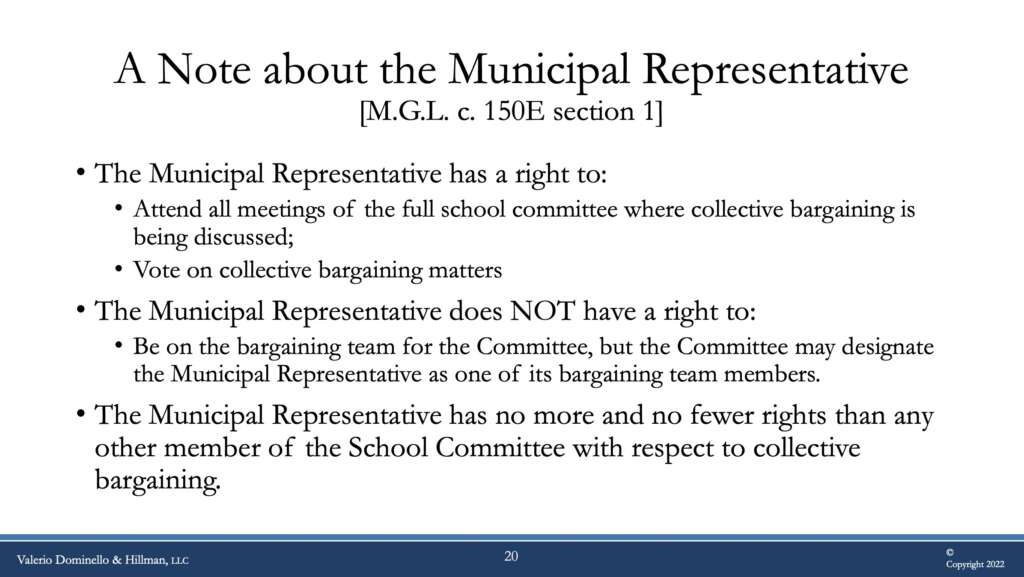
Here’s the full presentation:
The Bottom Line: Mostly false
- The claim (the Town Manager has no role): Mostly false. State law says the Town Manager, or a designee, participate and vote as a School Committee member in collective bargaining with school employees.
- The grain of truth: The Town Manager doesn’t negotiate school contracts for the town, and only gets to be part of the negotiating team if the school committee wants him to be a part of that team.
Put simply: the School Committee leads school bargaining and State law gives the Town Manager a vote in the process.