
Share This Article
Sudbury’s Finance Committee got its first extended look on Monday, September 14, at the menu of options town staff are weighing to close a projected Fiscal Year 2028 budget gap. The reception ranged from cautiously supportive to openly critical.
Assistant Town Manager and Finance Director Victor Garofalo walked the committee through the latest projections from the FY28 Budget Working Group, which has now met twice. The forecasted deficit has been trimmed from an original $3 million to roughly $1.925 million, thanks mostly to refined revenue estimates. But the conversation quickly turned from the narrowing gap to how the town intends to close what remains, and whether the proposed tools are prudent or merely a way to defer what appears to be in inevitable override based on the forecast.
Garofalo explained that updated figures had reduced the projected shortfall since the working group first convened. “During that time, we’ve got some information that allowed us to revise our numbers, thereby reducing the deficit to $1.925 million,” he said, cautioning repeatedly that the debt figures in particular remain estimates until the town borrows in December.
He also stressed that the expense side of the budget is not yet fully known. The projected school increases, he said, reflect what the cost centers themselves forecasted months ago, and they are not town-issued guidance. “These are not guidance numbers, these are purely projection numbers.” The Sudbury Public Schools’ submitted forecast assumes a hefty 4.48% increase for the Town’s largest cost center.
That distinction drew questions from member Mike Joachim, who noted the uncertainty about what the schools will truly need to maintain level services in FY28. “It’s what the cost centers have asked for, without any kind of review whatsoever by the town as to whether that’s a reasonable expense,” Joachim said.
Five Options
Garofalo then presented the five options staff are exploring to erase the remaining gap while preserving level services:
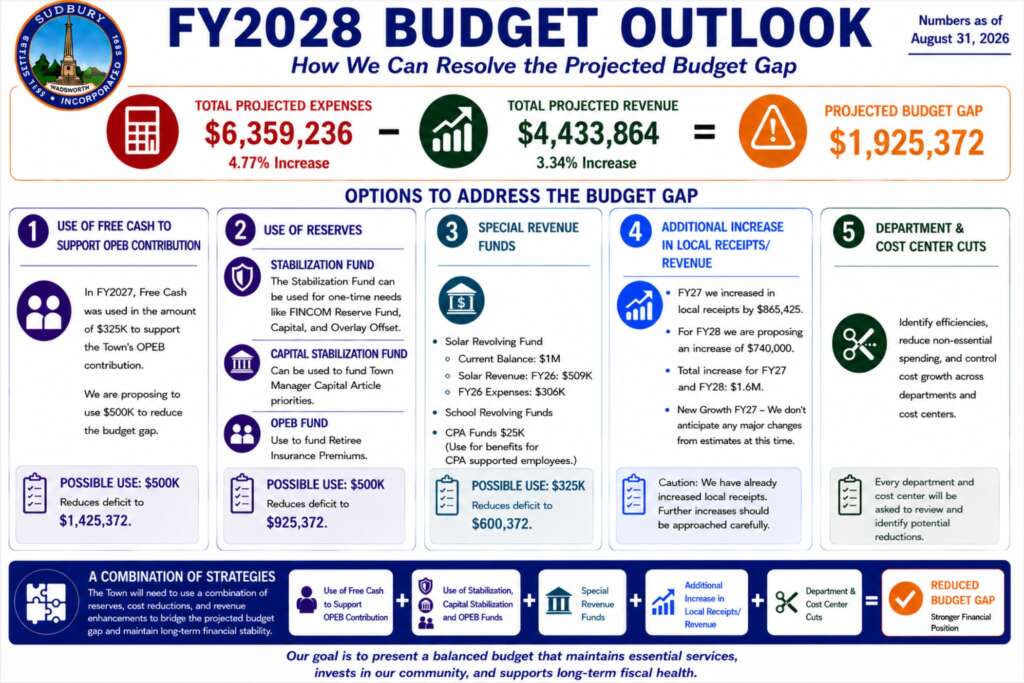
Garofalo later emphasized the list was not ranked. “There’s no priority order,” he told member Karl Fries. “I think you could take them as equally balanced, something from each of those buckets needs to be done.” He also framed the reserve-based options as a deliberate alternative to going to the ballot: “We don’t want to go and ask for an override when we have these reserves.”
“A band-aid on a hemorrhage”
The sharpest criticism came from member Eric Poch, who said he was “a little disappointed” and did not view options 1 and 2 as a strategic response. “I see them as being robbing from Peter to pay for Paul, and a lack of strategy, and a lack of oversight by the Select Board, which this committee has explicitly warned them about for the last three years,” Poch said.
He argued the approach undercuts the town’s own financial policies and its reserve-building discipline at the same time. “It’s duplicitous to use the [capital] stabilization fund, not have any protocol on how you withdraw from it, and then not be able to continue to contribute to it at the levels which are mandated in the policies themselves,” he said.
The financial policies do provide a protocol for withdrawing funds. They state: “Withdrawals from the Capital Stabilization Fund should be avoided until the target balance has been achieved. Once achieved, funds can be used towards items on the CIP. Once funds are used, the Town will seek to make annual contributions to the fund until the target balance is achieved.” The reserves policy also authorizes the use of reserves to fund the operating budget in limited instances: “With well-planned sustainability, Sudbury can use its reserves to finance emergencies and other unforeseen needs, to hold money for specific future purposes, or in limited instances, to serve as revenue sources for the annual budget. [Emphasis added, see pages 5 and 6 below)
Poch returned to the theme that the town has known this was coming. That’s technically accurate, but leaves out the fact that the Budget Working Group and staff were already explicit in saying this approach was a way to push an override out by a year or so, and doesn’t solve the structural problem. During the meeting Garofalo himself noted “We might be able to navigate fiscal year 28, but eventually we’re going to need that override. Something has to give, because it just can’t continue.”
He also pointed to the Massachusetts Municipal Association, which has been advocating at the State level for communities facing the same squeeze of health-insurance and fixed-cost growth outstripping what Proposition 2½ allows them to raise. But he was candid about the limits of local action: “There’s only so much we can do, and it really is relying upon our local legislators to help the communities.”
One-Time Money, Structural Deficit
Member Karl Fries offered a more measured version of the same concern, framing it in terms of long-term sustainability. Options 1, 2 and 3, he observed, “feel like using one-time sources to cover structural deficits.” He was particularly wary of the first two. “These were covered by the levy initially, and now covering them kind of outside of the levy, is effectively directing the levy resources that were covering these items now toward other things, covering the structural deficits,” he said.
“With my Finance Committee hat on, one and two seem much more risky from a long-term, sustainable perspective,” Fries said.
The Sorett Scalpel
Member Hank Sorett pushed in a different direction entirely, arguing the exercise amounted to “rearranging deck chairs” and that the committee should be hunting for deeper cuts. “I would like to see an effort to take a scalpel to bloat,” he said. “Where is the structural bloat in this budget? I know it’s there, I can smell it. But we’re not given the detail to be able to scrutinize it.” He likened the staff’s approach to “putting rouge on the pig.”
Sorett rattled off a list of targets: cutting the planning staff to one position, reducing conservation staff to half-time, eliminating spending on artificial intelligence and automated camera and data systems, ending police details, outsourcing the town fueling facility, and studying whether roads are repaved too frequently. He also floated regionalizing public safety command across neighboring towns. “I don’t know why Sudbury, Wayland, Concord, Lincoln, Lexington all have their own police chiefs,” he said.
Garofalo pushed back on the specifics, noting that most police details are billed to utilities rather than the town, and that the conservation staff costs the average taxpayer about $34 a year against a $16,000 average tax bill. The two also disagreed over whether the committee receives enough line-item detail; Garofalo maintained the budget book, drawn from the town’s financial system, already provides it. Sorett was unpersuaded: “We’ll buy you a scalpel if you want to use it.”
It Costs A Lot to Stay the Same
Ryan Lynch offered the meeting’s most direct message to members and residents alike, responding to Poch by putting the town’s predicament in the context of decades of deliberate choices. Sudbury, he noted, benchmarks near the bottom of its peer towns on both public safety spending and per-pupil school spending. There’s little to trim without cutting into services residents value.
“We’ve kind of all walked ourselves here through all of our policy choices that we have made over the last decades; just in terms of our efforts to preserve the historical charm of Sudbury,” Lynch said. “But that comes at a cost, and that comes at the cost of us foregoing business growth, personal property taxes that are the gift that keeps on giving for a lot of our peer communities that are making millions of dollars if they have good commercial tenants. We don’t have that.”
The consequence, he argued, is a near-total reliance on homeowners. “If we don’t have that, then we are kind of pigeonholing ourselves into a position where we are wholly at the debt of residential tax base,” he said. With public safety and schools already lean and class sizes something the town is unwilling to touch, Lynch said the budget doesn’t have much else to look at: “It’s town safety, it’s employee benefits, and it’s the school systems. And that’s the budget. That’s it.”
Lynch felt that left just two paths for FY28. “We’re either gonna cut some fat and we’re gonna utilize some one-time resources, which, again, I understand, per our own policies that we’ve done our best to follow, it’s not necessarily the most prudent thing for us to do. But it’s either that, or we’re gonna start cutting meat.”