


Share This Article
A rhetorical bridge appears to have been built between the operator of Camp Sewataro and one member of the Sudbury Select Board, as both parties have adopted the same phrase to describe residents calling for a formal planning process for the Town-owned property: a “small but vocal minority.”
The use of the phrase by Select Board member Dan Carty on social media was followed by nearly identical language used by Scott Brody, the camp’s operator, during a public comment session at the February 24 Select Board meeting.
The comments may touch a nerve with residents who could argue that the characterization by Carty and Brody ignores the historically narrow margin by which the property was acquired—a margin that remains one of the tightest in Sudbury’s recent history of big-ticket votes.
A Shared Script?
Over the course of three posts to the “Friends of Sewataro” Facebook group in recent weeks, Select Board member Dan Carty repeatedly used variations of the phrase “Don’t let a small but vocal minority be the only voices heard.”
That language reappeared during the February 24 meeting of the Select Board when Scott Brody addressed the Board and community members. Brody told the board “There is a small, very vocal minority of folks in Sudbury who have expressed grave concerns about the location of the camp program during the summer months. And as much as we have tried to do everything we have been asked to do and more, I don’t know that we can ever undo the original sin that seems to exist from the original town vote in voting to approve the purchase of the site.” (19:00)
While Brody supported the long-term planning process the Select Board has been discussing, his comment appeared to minimize some proponents of the process as mere opponents of the original acquisition.
The phrase is more than just a descriptor; it is a tactical piece of political messaging with a specific historical weight.
The phrase “small but vocal minority” is a rhetorical inversion of the “Silent Majority,” popularized by President Richard Nixon in 1969. By labeling dissenters as a “vocal minority,” a speaker implies that the vast majority of the population actually supports the status quo but simply isn’t as loud. Historically, this tactic is used to delegitimize opposition by suggesting their concerns are unrepresentative of the general public, effectively shutting down debate without addressing the underlying arguments.
The Data Tells A Different Story
While the phrase suggests a lopsided consensus in favor of the current Sewataro trajectory, voting records tell a different story. When compared to other major “big-ticket” projects and land acquisitions in the last decade, the Sewataro vote stands out as an outlier.
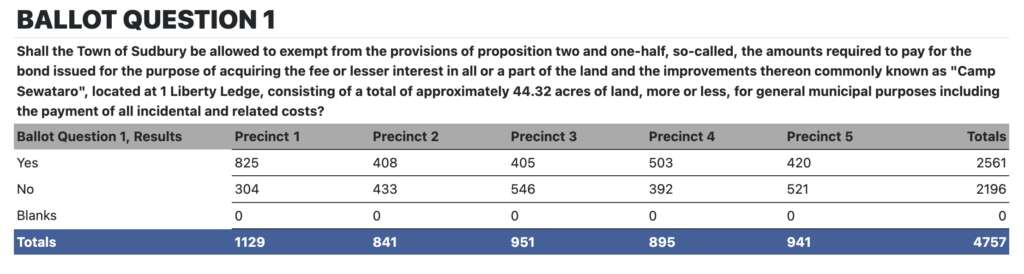
The 2019 vote to acquire the property had a slimmer margin of victory than any recent land acquisition in Sudbury. Voters approved the acquisition 2561 in favor, and 2196 opposed. The 54% majority in favor fell short of the Broadacres Farm acquisition one year earlier. The 2018 Broadacres Farm vote was 6014 in favor and 3069 opposed, amounting to a 62% majority.
A majority of Sudbury’s precincts, three of five at the time, voted “no” on Sewataro. However, the vote in Sewataro’s home precinct (Precinct 1) was also an outlier. In addition to having the highest turnout, 73% of voters in Precinct 1 voted in favor of the acquisition, compared to the much smaller 54% overall majority.
There are several points of comparison in recent years to put the vote in context. The construction of the Fairbank Community Center, which was similarly contentious for many years, passed with a slightly larger 55% majority in 2020. In that same timeframe, 67% of voters approved of the acquisition of the CSX Corridor, which supported completion of the Bruce Freeman Rail Trail.
Voters were more closely split on Sewataro than most other significant votes in the past decade. In fact, every Sudbury precinct voted in favor of Broadacres Farm, the CSX Corridor and the construction of the Fairbank Community Center, while a minority of precincts voted in favor of Sewataro.
Resident Voices
The Select Board voted this week to establish an advisory committee of seven residents that will evaluate uses of the property and develop a report for the Select Board to consider. Outside of a single “Flash Vote” survey in 2019, the advisory committee is the first opportunity provided to residents to weigh in on an open-ended planning process that was described to residents ahead of the vote to acquire the property in 2019. The “lease to camp operator” option was presented as means to buy time for proper planning. (Page 19)

But there are other ways to gauge resident sentiment, and one of them is a vote by pocketbook that Brody alluded to in his comments on Tuesday. Over 500 campers at Camp Sewataro are Sudbury youth — a number that has been steadily growing since Brody took over camp operations.
On the flip side of that, the resident swim program at Sewataro has failed to garner much public interest at all. A memo from Town Manager Andy Sheehan recently told the Select Board “The program has seen unspectacular use.” Sheehan went on to quantify the limited number of residents who took advantage of the program. (The swim program will be back this summer, but for fewer days.)
While there are a variety of datapoints from the past six years that provide conflicting indications of resident opinions, there’s no authoritative data available to provide a holistic view in 2026. The advisory committee is tasked with collecting public input, and will likely have to develop an approach that captures a more definitive picture of resident sentiment and desires than has been compiled in all the years since the 2019 acquisition.
One thing is for certain — the Liberty Ledge/Sewataro Advisory Committee is not tasked with a binary choice between having a summer camp and not having a summer camp. It’s tasked with exploring “possible uses of this town-owned property.” With the breadth of that charge, it would appear that the committee is positioned to capture the full breadth and variety of resident perspectives across town… a far cry from a simplistic “majority/minority” position on a single use of the Town-owned property.