



Share This Article
The December 4 meeting of the Sudbury Public Schools School (SPS) Committee meeting featured a multi-hour discussion about the Fiscal Year 2027 (FY27) budget and school finance. The committee pressed repeatedly to understand how the initial budget forecast could unexpectedly show a $1.6M deficit for the next fiscal year, but the SPS administration insisted the numbers only came together very recently and that this was a normal part of their budget building process.
Town Manager Andy Sheehan and Assistant Town Manager/Finance Director Victor Garofalo were in attendance for the discussion, and also presented information about Chapter 70 State aid, free cash, and all the costs carried by the Town on behalf of the school district. They also pressed on some of the budget drivers presented by SPS Superintendent Brad Crozier and Director of Business and Human Resources, Don Sawyer.
The Perfect Storm?
The gist of the conversation was captured in one exchanged where Sawyer asked why Garofalo was estimating Medicaid reimbursements roughly $60,000 below where they came in last year. After Garofalo explained his logic, Town Manager Andy Sheehan chimed in to tell Sawyer “I get the point, but we’re looking at a 1.6 million dollar deficit and we’re talking about a difference of what, 60,000 dollars? So you’re kind of rearranging the deck chairs on the Titanic and there needs to be a bigger conversation and a harder look at the totality of what’s out there. I think focusing on $60,000 when your deficit is $1.6 million is not going to be fruitful.”
Garfalo added “Also, if you look at the budget, you got a 3% increase last year and we increased the school budget by $120,000 dollars. So, you have to look at that too. The fact is that we did adjust your budget because you looked for $120,000 dollars more last year, which we did not give to L-S and we did not give — in fact the Town Manager’s budget came in less than the guidance budget — so again you’re focusing on $60,000 but we saw an increase in your budget of $120,000.” (1:31:50)
One of the challenges in the conversation was discerning what was going on with the budget drivers reported by Sawyer and Crozier. Garofalo questioned the utility increase estimated by Sawyer, noting that the new rates locked in with Sudbury’s Community Electricity Aggregation program should provide massive savings for SPS, but Sawyer was still projecting them as a driver of the budget deficit that was being reported. Even that exchange didn’t provide any additional clarity. (2:12:00)
The biggest point of confusion was the “salary contractual obligations” line item, which Sawyer estimated at an increase of over $2M for FY27.
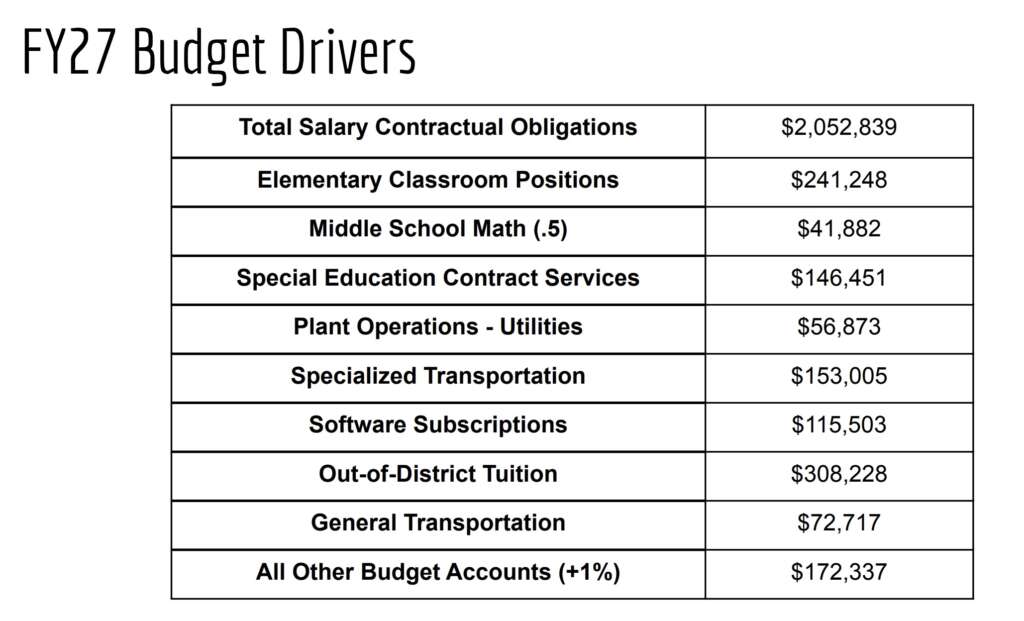
The SPS school committee and administration were limited in what they could say about contractual obligations because negotiations with the union groups are still ongoing. However, it was clear from the comments of Chair Karyn Jones, Vice Chair Jessica McCready and member Betsy Sues that they didn’t believe the $2M+ was entirely attributable to the contract currently being negotiated. However, they weren’t able to get into specifics as that could reveal the total amount on the negotiating table for union contracts.
Chair Karyn Jones pressed the administration on when they knew they were looking at such a large deficit for FY27. Both Sawyer and Crozier insisted that the information only came together in the last couple weeks. (2:11:00)
Comparisons were drawn to Lincoln-Sudbury Regional High School, which appeared to have far greater insight into their FY27 budget far earlier than SPS, allowing Superintendent Andrew Stephens to collaborate with Town Manager Sheehan to maximize guidance and minimize their initial shortfall.
McCready stated “I guess I don’t understand how the projection was so wrong that we’re now needing, potentially, a 7 percent increase.” Sawyer insisted the numbers add up and they could discuss in a scheduled executive session on the following Monday.
Gone With The Wind?
Sheehan and Garofalo pressed the group to have the discipline to make the budget work from one year to the next, pointing out that the Town had clearly signaled for multiple years that they were forecasting worsening financial conditions heading into FY28. The point was clear — while multi-year forecasts are less accurate the further out you look, it’s reasonable to expect that a forecast would show signs of something as big and concerning as a $1.6M deficit.
Budget discipline, in this case, could mean painful cuts in the year ahead.
Vice Chair Jessica McCready said “I agree with Nicole [Burnard], I understand what you’re saying that we have to start to identify things to cut and that’s very unfortunate. So what I would like to understand is how we got to the point where we have such a deficit so that next year we don’t have to do this again where we say ‘okay well now we’re in the hole again.’ We had the override in 2024 that maybe wasn’t enough money to get us out of where we need to be now. So we’re in this huge hole now, which is really unfortunate, and what are we going to cut? That’s terrible that we’re thinking about what we’re going to sit here and cut. And my questions stem from — I don’t want to ever be in this position again where we have to sit at the table and say we have to cut.”
The conversation meandered, but the theme of budget discipline and sustainability persisted. Late in the conversation Garofalo pressed Sawyer on the use of one-time ESSER funds for approximately $250,000 in staff positions each year over the course of three years. Sawyer insisted that SPS was able to absorb that into the budget after the ESSER money ran out and added “We do a very good job in forecasting and making decisions long term.”
Sheehan soon reiterated that the forecasted $1.6M deficit was a complete surprise that “came out of nowhere” for the Town. Sawyer responded “And I can understand that.”
The conversation did not unearth any real explanation for a surprise $1.6M deficit, but Sawyer and Crozier reiterated it was just a starting point for the usual budget building process, indicating that it will change substantially over the next month. They did, however, ask for extra time to submit their recommended budget to the Town Manager early next year.
Great Expectations?
At the conclusion of the meeting, the SPS School Committee discussed how SPS leadership did not participate in the capital planning meetings earlier this year, despite being invited by the Town Manager’s office. Crozier explained that he is invited to the capital planning meetings, but is not consulted first to see if the time of the meeting will work for his calendar. He described the meetings being “plopped” onto his schedule.
After some back and forth about meeting scheduling dynamics, Member Betsy Sues made it clear what the committee expected of the administration moving forward. “I think the expectation from my perspective, this is probably more on the budget than the capital planning, but we’re all professionals here. We just need to make the appropriate meetings so people aren’t surprised. And it sounds like this was a big surprise.” (3:20:00)
Crozier interjected “But there was no meeting.” Sues responded “But then you should have organized the meeting and been proactive. I’m not saying whether it’s fair or not fair. But we all need to avoid surprises.”
Crozier responded “Okay.”
The full SPS budget presentation from December 4 is on page 37 below.