Share This Article
The Liberty Ledge/Sewataro Advisory Committee (LLSAC) has been meeting frequently this summer as they work to deliver recommendations on future uses of the property to the Select Board this fall. The committee hit a major milestone today, as it issued a survey that had been envisioned earlier in their process. (Survey here.)
But there’s some chatter swirling around Sudbury questioning the work of the members of the committee, their motives, and their qualifications. A presentation in a recent meeting from the Sudbury Housing Trust appears to have set off concerns about housing being developed on the property.
Soon after the Town released the survey today, some residents openly criticized the survey’s design on social media. One resident commented “This survey is awful and so clearly skewed towards gathering support for their housing plan. Despicable.”
The LLSAC has made no recommendations on uses of the property, housing or otherwise, and is scheduled to discuss “initial options” for the first time on Thursday. What the committee has done is gather input from stakeholders, ranging from private residents to Town department heads and other boards and committees.
On Thursday the committee will welcome Sudbury’s Conservation Department and the Commission on Disability for their input on the property.
To date, the committee has met with:
- The camp operator for a site visit
- The camp operator for an in-meeting presentation
- Director of Planning and Community Development, Adam Burney
- Assistant Town Manager and Finance Director, Victor Garofalo
- The Sudbury Housing Authority
- Dozens of residents during a dedicated listening session at the Fairbank Community Center (nearly 40 in person and another 20 online according to Town staff.)
- Director of Health and Community Services, Vivian Zeng (Her department includes Parks and Recreation)
- Camp Operator Scott Brody for the presentation of a 5-year plan
- The Sudbury Housing Trust
- Many residents during robust, repeated and free-flowing public comment periods during most meetings
The committee already published the results of the public listening session, which showed strong support for continuing Camp Sewataro operations, and strong support for additional programming on the property depending on how you interpret and cluster the similar uses. That’s below:
The committee also published the tentative schedule that runs through their deadline to submit a report to the Select Board:
What’s The Fuss?
In short, the Sudbury Housing Trust (SHT) presented their desire to explore housing opportunities in two areas on the outermost edges of the property. One area on and around Haynes Road and another area on Greystone Lane.
SHT Chair Carmine Gentile told the LLSAC that the single-family house at 213 Haynes Road had the highest potential to “further the goals and mission of the Housing Trust.” He added that camp operator, Scott Brody, had already suggested to him that the house, which is unoccupied, could be made into an affordable housing unit.
The land with frontage on Greystone Lane was described as a potential area for owner-occupied housing. Another parcel on Haynes Road was cited, and another parcel with frontage on Liberty Ledge was also mentioned. Gentile was indicating areas that could be explored for housing potential, but not advancing any specific proposals. The message from the Trust was to advise the LLSAC to comprehensively evaluate the property for housing potential, while identifying areas of interest for further exploration.
During discussion, LLSAC member Debbie Dineen immediately raised doubts and pumped the brakes on the development potential of much of the site. She cited bedrock that had risen to the surface in one area. “The hatched area is all bedrock just below the surface. The red area is bedrock that has broken through the surface.” She concluded “It doesn’t look like, maybe half the site, doesn’t look like it’s really conducive to development at all.” She then added “All I’m saying is just because there’s an area that’s not built on, doesn’t mean it can be.” (1:40:30 below)
While no formal and specific housing proposals have been made, and the LLSAC hasn’t made any recommendations on future uses of the property, the process of gathering input appears to have triggered fears of a hidden agenda to develop the property.
Back to the Beginning
Importantly, the fears are anchored in the original intent of the property acquisition. It was clear when the property was purchased in 2019 that the Town wanted to control its fate by purchasing the land, rather than allowing developers to scoop it up and do what they will. The presentation before the Town Meeting vote raised concerns about capacity in the schools and added costs for the Town if the full property was developed and populated.
As with many municipal property acquisitions, one clear reason for the acquisition was to prevent large-scale development in the future. Discussion of housing development on the property, no matter how modest, is likely to be perceived as a departure from the intent of the acquisition.
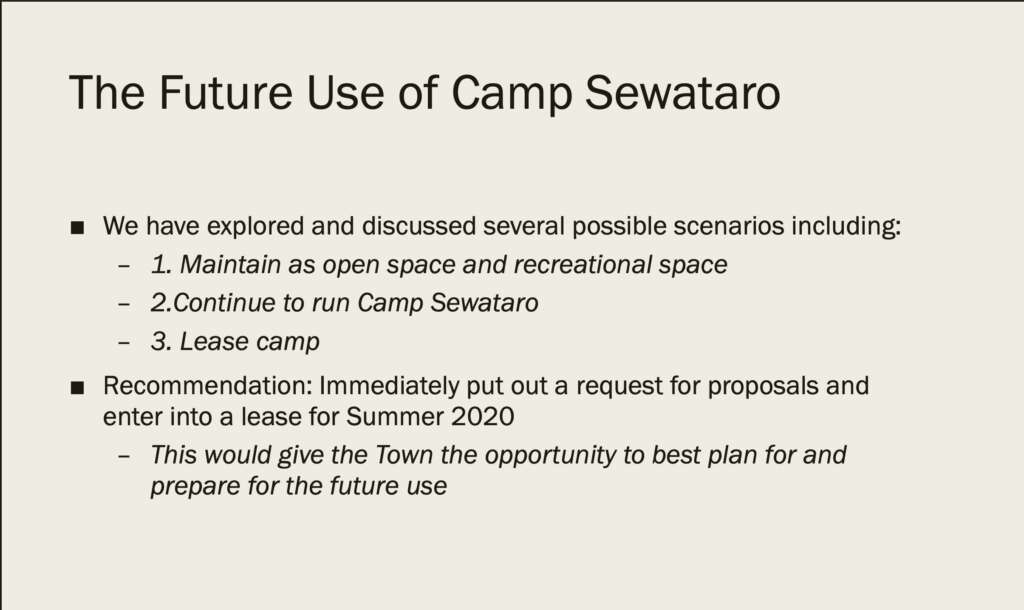
But the same presentation also told residents that leasing to a camp operator would provide time for the Town to plan future uses. “This would give the Town the opportunity to best plan for and
prepare for the future use.”
The LLSAC was formed seven years after the Town had told voters that a planning process would follow. For residents who expected some follow-through, that’s a long wait. The other tension, however, is that the current planning process is exploring all uses, including a version of a use (housing) that many voters feel the acquisition was intended to prevent against.
Concerns about a perceived bias towards housing development in the survey issued by the LLSAC today ultimately come down to survey design by a volunteer committee that’s tasked with information gathering and recommendations anchored in public input, not decision making.
Notably, Town Meeting voted down an article in May that would have funded a professional consultant to facilitate the public input process. The report on the article made it clear that such a consultant would base any reporting on public input. “Under the direction of the Town Manager, the consultant will support Town staff and any duly appointed public body designated to oversee the visioning effort by providing guidance on best practices for community engagement, facilitating the identification of opportunities and constraints, conducting studies, and preparing a summary of potential conceptual options based on public input.”
In the absence of that professional support, the survey was more of a “DIY” effort. Residents themselves will decide on the relative strengths and weaknesses of the survey design. But that won’t change the fact that the LLSAC isn’t going to decide the fate of the property.
Some residents have called for a “long-term lease” for the camp operator. There’s just one catch: The Select Board probably can’t do that unilaterally. The current arrangement is a license, not a lease, which is why it didn’t have to go through Town Meeting. If the Town pursues a long-term, lease-like disposition under the banner of a “license,” it could find itself in a pickle.
The Select Board would likely have to issue a competitive solicitation under State law, and they would have to get authorization from Town Meeting for such a lease. In fact, most changes in use or any form of disposition of land have to go through Town Meeting. Any kind of owner-occupied housing at Sewataro would have to make it through Town Meeting as well.
The LLSAC is collecting input from a broad array of stakeholders in a planning process that was promised seven years ago. They can make recommendations, but they can’t make decisions. The Select Board will take that report under consideration. And the ultimate outcome, if this process doesn’t end in a five-year extension with the current camp operator, will almost certainly be determined by Sudbury residents.