



Share This Article
The Sudbury Public Schools School Committee voted 3-0-2 on Monday, October 19, to approve a revised 2027-2028 academic calendar that officially adds Eid and Diwali as recognized school holidays. The adoption of the second calendar draft in their meeting packet, which extends the school year by two days to accommodate the new closures, concludes over a year of heightened community advocacy, but left some committee members criticizing the process that brought the final draft to the table.
Under the newly approved calendar, the district will close on October 29, 2027, for Diwali and May 5, 2028, to observe Eid al-Adha. To satisfy the state’s 180-day instructional requirement, the district’s planned last day of school will be pushed back from June 13 to June 15, with the 185th-day weather buffer extended to June 23. In 2028, Eid al-Fitr falls on a weekend. The vote could extend the school year by 3 days in future school years. Based on last year’s calendar discussions, further negotiation with the teachers may be required to implement this calendar.
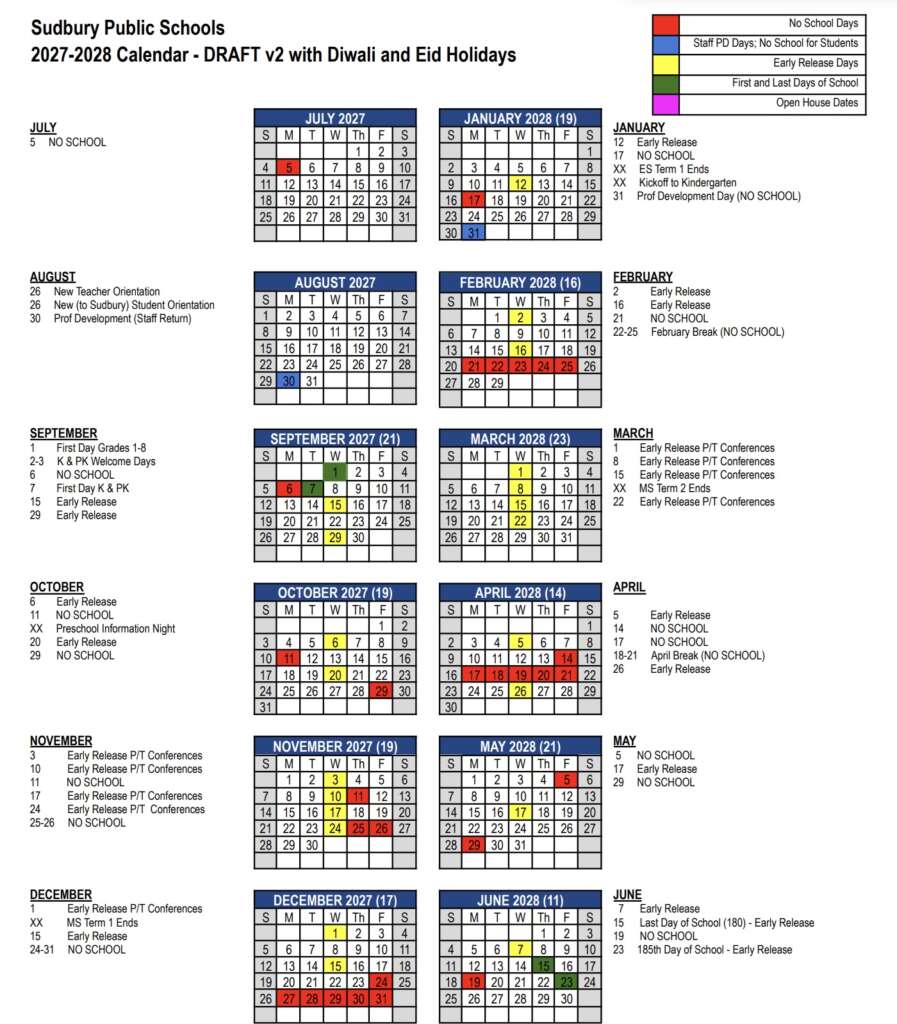
The push to recognize the holidays received a significant boost from the Sudbury Diversity, Equity & Inclusion (DEI) Commission. In a memo to the Committee, the Commission strongly advocated for the additions, adding that explicitly naming the holidays fosters a sense of belonging and aligns the K-8 district with the Lincoln-Sudbury Regional High School (LSRHS) calendar. A prior committee removed the names of the holidays from the calendar in 2022. During the meeting, the committee voted to add the names back to the calendar.
The vote revealed strong differences of opinion on the Committee. The measure passed with three votes in favor from Chair Jessica McCready, member Julie Durgin-Sicree and member Ellen Lederer-DeFrancesco, while member Karyn Jones and Vice Chair Betsy Sues abstained.
Jones openly criticized the process, citing a lack of transparency in how the final drafts were brought forward and a lack of community engagement about the changes ahead of the vote. When she was voting, she described the process and action as “a failure.” During deliberation she noted that last year there were community and staff surveys, a dedicated subcommittee, and listening sessions.
Members specifically called out the omission of Lunar New Year from the newly recognized holidays. Lunar New Year was heavily featured in the Committee’s tense calendar discussions a year prior. McCready explained to Lederer-DeFrancesco that the committee had received ongoing input about Eid and Diwali after last year’s calendar discussions, but hadn’t received much, if any, community input on Lunar New Year.
The debate over the 2027-2028 calendar serves as the latest chapter in an ongoing community dialogue regarding religious and cultural equity in Sudbury’s schools, but also committee processes and communication with the community. While the approval of a calendar is complete, the pointed critiques from Jones and Sues suggest that the conversation around how SPS manages and communicates its academic calendar remains unsettled.