



Share This Article
The Sudbury Housing Authority wants to replace four aging homes with eight affordable units. A 2024 state law now allows accessory units by right.
The Sudbury Housing Authority (SHA) has received a single bid to move ahead with its long-debated plan to add affordable housing units in the Pine Lakes neighborhood, and the proposal reflects a shift in State law that has quietly reshaped the project since neighbors first raised their objections.
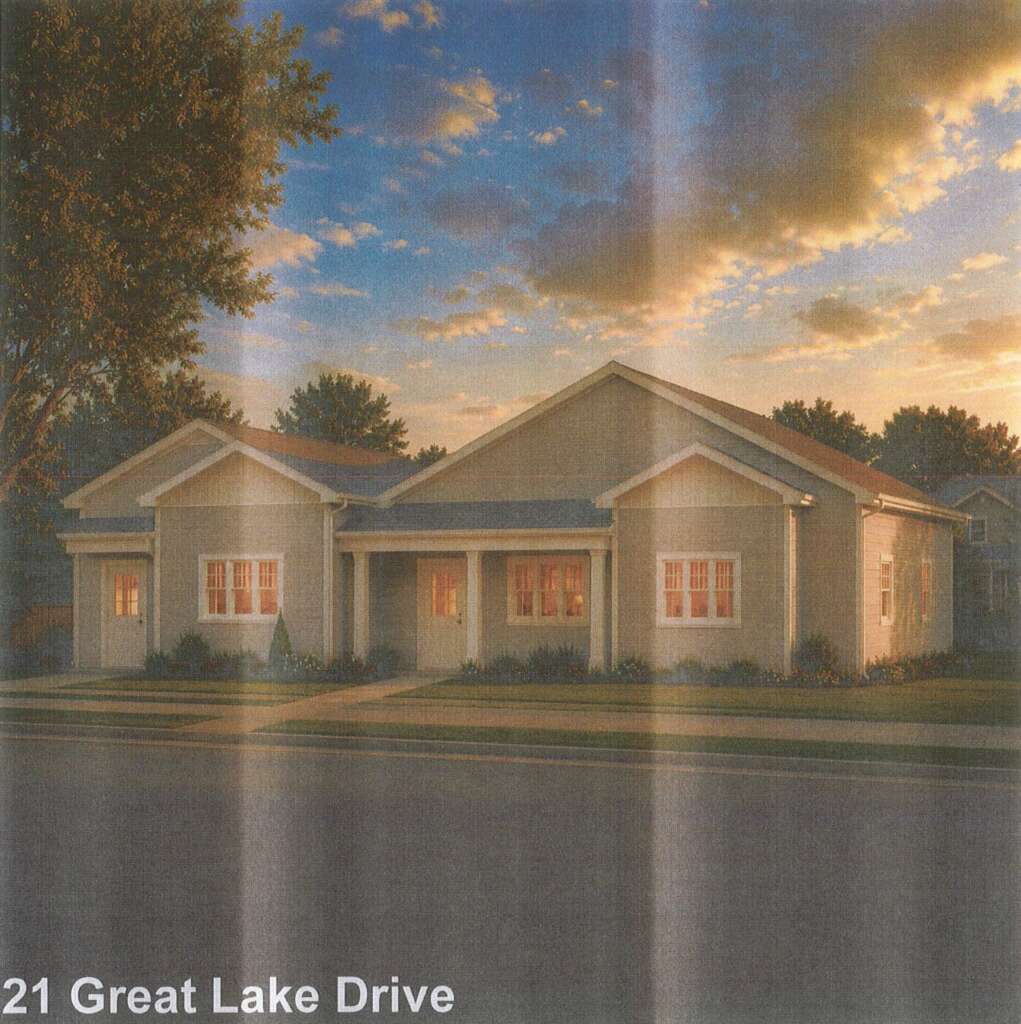
For years the SHA described the plan as converting four of its single-family houses into duplexes. The winning bid, submitted last month by the modular builder MassDwell Solutions, accomplishes the unit increase under a different name: each of the four sites would become a single-family home with an attached accessory dwelling unit; a configuration Massachusetts now permits by right. If the project proceeds, the outcome on the ground is the one the SHA has long described, doubling the number of family units on those lots. (Technical proposal below)
The SHA controls the houses at 21 Great Lake Drive, 8 Oakwood Avenue, 2 Beechwood Avenue and 9 Richard Avenue, and it has been working since 2021 to put more families in them, including winning a competitive State grant and rental-voucher award to pay for it.
According to the SHA, more than 16,000 families sit on its State public-housing waiting list, and the greatest demand is for smaller units. Replacing four single-family homes with eight smaller units, the SHA has argued, lets it serve more families on land it already has.
Many Pine Lakes residents have opposed that densification from the start. Their concerns have consistently highlighted increased density in an already-dense neighborhood, more units and more cars on small lots, and new buildings that may not match the character of a neighborhood of single-family homes. They have also argued that the repair path would house families sooner than the demolish-and-replace option. There have also been concerns raised about how the SHA operates, and efforts to direct the SHA’s attention to other locations in Sudbury.
In May, Town Meeting appropriated $500,000 of the Town’s free cash, by way of a Citizen’s Petition, to repair the single-family homes and keep them as-is. (Presentation of the petitioners below.)
What’s new is the central distinction the bid now turns on. It’s a distinction between duplexes and houses with accessory dwelling units.
So what actually separates the two? A duplex, or two-family home, is one building with two dwelling units of equal standing. Neither is the “main” home. An accessory dwelling unit is, by definition, the junior partner: a complete, independent unit, but one that must be smaller than and secondary to a principal single-family house on the same lot. Sudbury’s updated bylaw follows the State law, and caps such a unit at 900 square feet or half the floor area of the main house, whichever is smaller. That technicality is what keeps an accessory unit from simply being half of a duplex.
Under the Massachusetts Affordable Homes Act of 2024, and the local bylaw the Town adopted to match it, a single accessory dwelling unit is now allowed by right in single-family zones. They are approved through the ordinary building-permit process rather than the path a duplex would require. The bid follows the path the State opened, one that the SHA told residents could be coming as much two years ago.
In an August 2024 question-and-answer sheet the SHA noted that “local zoning changes are anticipated as a result of recent statewide changes in regulations around ADUs that promote their development.”
ADU’s are not new to the area, either; the Town has already permitted several of them elsewhere in the Pine Lakes neighborhood and around town.
The ADU path does not mean the project escapes review. The SHA will still need to go through the Zoning Board of Appeals for every site, and those are public hearings where neighbors can be heard. The SHA also has to determine if their current funding sources can be applied now that the project has shifted its approach and classification from duplexes to single-family homes with ADUs.
Notably, the bid does not pretend to be something it is not. Its cover materials still describe the sites as duplexes even as its zoning analysis classifies them as homes with accessory units. They explain their strategy plainly in the technical proposal:
“The RFP refers to the project as a redevelopment into four two-family homes. The team evaluated the duplex (two-family) configuration and selected the Principal + ADU configuration instead. A two-family duplex in A-Res requires a Special Permit for two-family use — a discretionary use approval with abutter notice, public hearing, and a four-fifths supermajority. The Principal+ADU configuration delivers the same number of dwelling units (two per site, eight total) under a procedurally lighter framework: only the GFA increase triggers the ZBA, and the ADU itself is by-right and state-protected. Schedule and political risk are materially lower under Principal + ADU.”
If the SHA advances the bid, the team expects to file its zoning applications together and estimates roughly six to nine months from “predevelopment to Notice to Proceed.” (Zoning narrative below, timeline on Page 12)
The plan would add four additional affordable units for families who need them; it would also add households and buildings to a neighborhood that has consistently opposed them. The State’s recent embrace of ADUs has not dissolved that tension. It might just bypass a discussion over whether the second units are allowed, and shift it to a narrower conversation about how the new homes will look and fit in the neighborhood. Though much depends on the applicability of the funding source the SHA has available and a series of critical predevelopment steps.
Drawings: